


Analysis: PBSA rental growth across European cities is slowing down
Across Europe, PBSA rents continue to perform in line with inflation across several markets, but the pace of increase is moderating.
As inflation stabilises and affordability pressures increase, operators are moving towards a more measured pricing approach to protect occupancy while maintaining profitability.
If you are short on time:
Continental Europe performance
Average PBSA rental growth in Continental Europe stood at 3.5% in 2025, slightly above the UK’s 2.8%
Moderate growth
Rental growth continues to outpace inflation in several markets, but the pace of increase is moderate compared with previous years.
Cost pass-throughs
As inflation gradually moves closer to pre-pandemic levels, the pressure to pass rising costs through to rents is expected to weaken.
Affordability limits
Affordability is becoming a key constraint, meaning future rental growth is likely to be more selective, market-specific and occupancy-led.
Rental growth still outpaces inflation, but momentum is slowing
PBSA rental growth across Europe remains positive, supported by ongoing student demand, limited supply in many cities and continued pressure on operating costs.
However, the pace of rental increase has moderated compared with the previous period of rapid growth. Across European markets, rental growth is expected to stabilise closer to 3%, as operators adopt a more gradual approach to pricing.
This shift reflects a more balanced environment. Operators still need to protect margins, particularly as labour, financing, development and operating costs remain elevated. At the same time, affordability is becoming an increasingly important constraint on future rent increases.
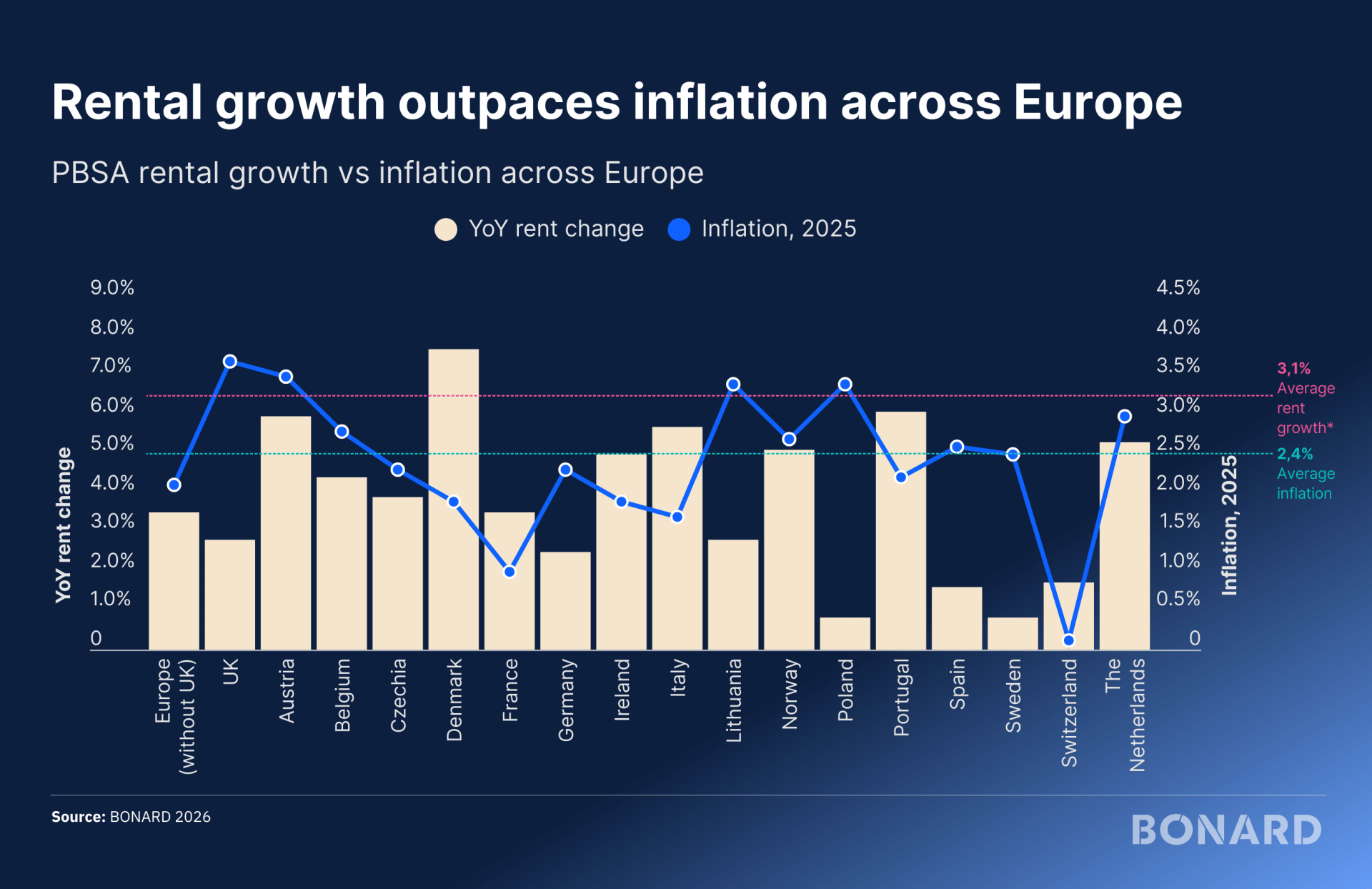
Continental Europe shows stronger rental growth than the UK
Average PBSA rental growth in Continental Europe reached 3.5% in 2025, compared with 2.8% in the UK.
Average PBSA Rental Growth (2025)
3.5% Continental Europe
2.8% United Kingdom
This difference can partly be explained by the different maturity profiles of the two markets. The UK is one of the most established PBSA markets globally, with a deeper existing stock base and more developed pricing structures.
As a result, rental growth in the UK is increasingly shaped by affordability constraints, competition within mature city markets and a more limited ability to push rents materially above already elevated levels, particularly in higher-priced locations such as London and other major university cities.
By contrast, many Continental European markets remain in a more active growth and institutionalisation phase. In several cities, PBSA supply is still relatively limited, while demand from both domestic and international students continues to strengthen.
This creates more room for rental uplift, particularly where new, higher-quality schemes are entering markets that have historically relied on private rented apartments, informal housing or university accommodation.
Product quality and market maturity are shaping pricing power
Rental growth in Continental Europe is not driven by demand alone. In many markets, it is also supported by a shift in product quality and positioning.
Lower starting bases
Where PBSA rents started from a lower base, operators have had greater scope to reprice as the sector matures and as students become more familiar with professionally managed, amenity-rich accommodation.
The product premium
Newer schemes can often command higher rents because they offer a stronger product proposition, including better design, services, amenities, management quality and location.
For investors and operators, this means that future rental growth will increasingly depend on product-market fit. Markets with limited supply and strong demand can support rent increases, but only where the product remains aligned with student budgets and expectations.
Inflation remains a key driver of PBSA rental growth
Inflation remains one of the main drivers of rental growth across the private PBSA sector.
Current stabilisation base
~2.5%
Medium-term target goal
2.0%
Following the sharp increases recorded in 2022 and 2023, inflation has started to stabilise, with most European markets moving towards a more moderate environment of around 2.5%.
Despite ongoing geopolitical uncertainty, policymakers generally expect only limited near-term upward pressure, with inflation gradually moving back towards the 2% target over the medium term.
As inflation normalises, the cost-driven rationale for above-average rent increases is expected to weaken. Operators will still need to manage elevated operating, financing and development costs, but the scope for continued sharp rental growth is likely to become more limited.
Affordability is becoming the main constraint
While demand fundamentals remain supportive, PBSA rental performance will be increasingly shaped by affordability.
The purchasing power threshold
This is particularly relevant as PBSA rents have risen faster than disposable household incomes in several markets. Domestic students and internationally mobile students ultimately depend on household income, purchasing power and, in some cases, currency movements in key sending markets.
As rent burdens increase, students may become more selective, trade down in product type or consider alternative accommodation options.
For operators, this creates a more delicate pricing environment. Rental growth can remain positive, but aggressive increases may begin to test affordability and occupancy, especially in markets where rents are already high or competition is increasing.
What does this mean for stakeholders?
The overall pattern suggests that PBSA rental growth is no longer driven by demand alone.
The strongest rent increases are generally found in markets where demand growth, limited supply, rising costs and product modernisation overlap. These are markets where operators have both a demand base and a product rationale for rent uplift.
On the other hand, weaker growth is more likely in markets where affordability limits, regulation, competition or already-high rent levels constrain operators’ ability to pass through further increases.
As a result, operators are likely to face a more balanced pricing environment, where rental growth remains positive but more measured than during the recent period of rapid increases.
For investors, this makes market selection, product positioning and affordability analysis increasingly important when underwriting future rental growth assumptions.

“PBSA rental growth remains positive, but pricing power is becoming more selective. The strongest markets will be those where demand, limited supply and product quality support rent increases without undermining affordability.”
Ina Durcekova
Real Estate Consultant, BONARD
For a deeper understanding of PBSA rents, inflation, supply-demand fundamentals and asset-level benchmarks, explore the BONARD Platform or learn more about how BONARD tracks student housing performance across markets.

For tailored advice on evaluating student housing investment opportunities and rental growth assumptions, contact Filip to explore how he can support your next acquisition or development strategy.



SUBSCRIBE TO STUDENT HOUSING INSIDER
Stay close to the student housing market
Subscribe to Student Housing Insider for a weekly update on student housing transactions, development pipeline, market trends and selected BONARD analysis.
Designed for investors, developers, operators, lenders and market participants tracking the student housing sector.