


Analysis: Ireland’s international student boom and what it means for student housing
Ireland’s international student enrolments are rising strongly, supported by stable visa pathways, post-study work opportunities and growing global demand for English-taught education.
For student housing investors, this is an important demand-side signal, but sustaining growth will depend on capacity, accommodation supply and source market resilience.
If you are short on time:
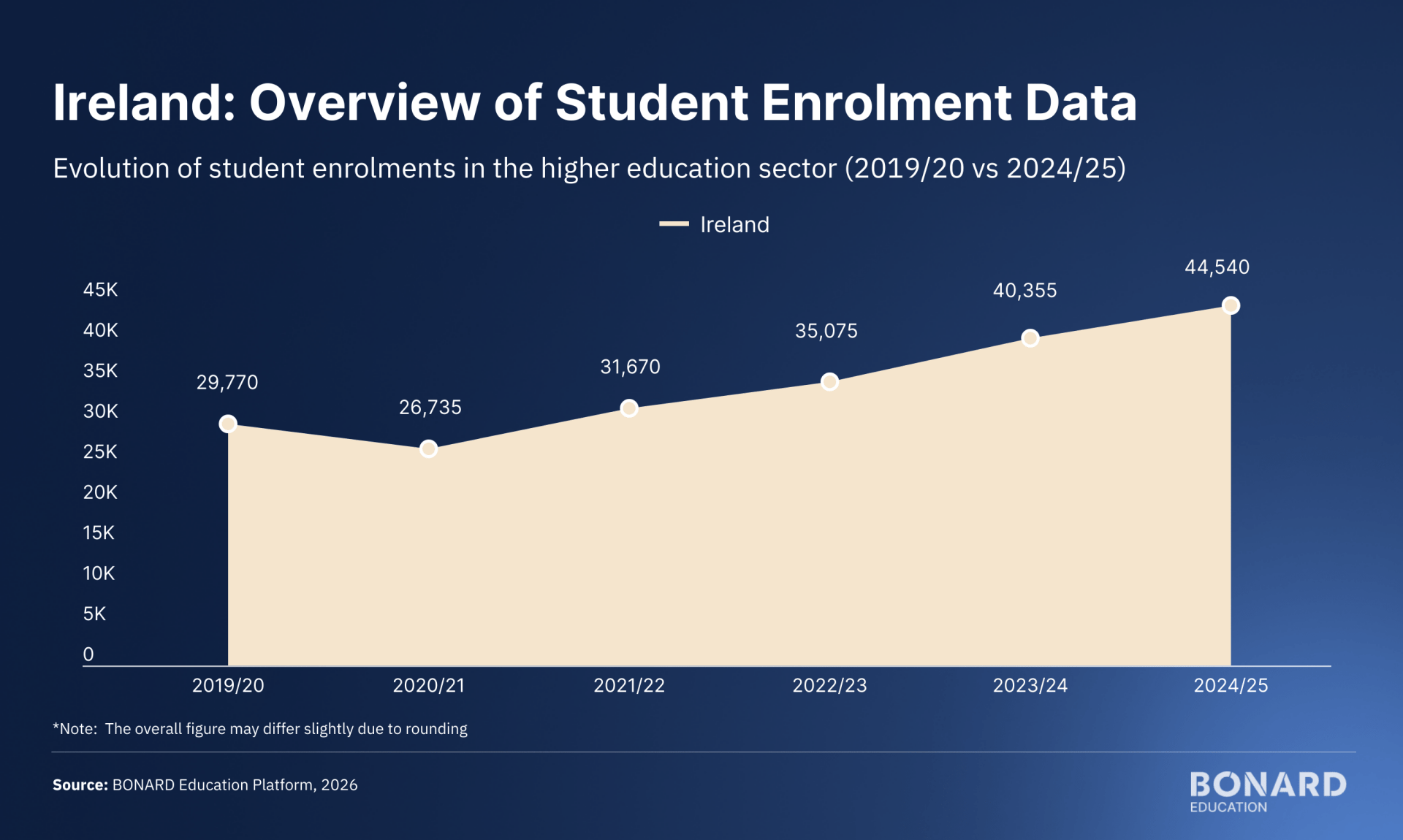
Ireland recorded 44,540 non-Irish domiciled student enrolments in 2024/25, up 10.2% year-on-year;
Non-EU students account for 32,940 enrolments, with an almost even split between undergraduate and postgraduate demand;
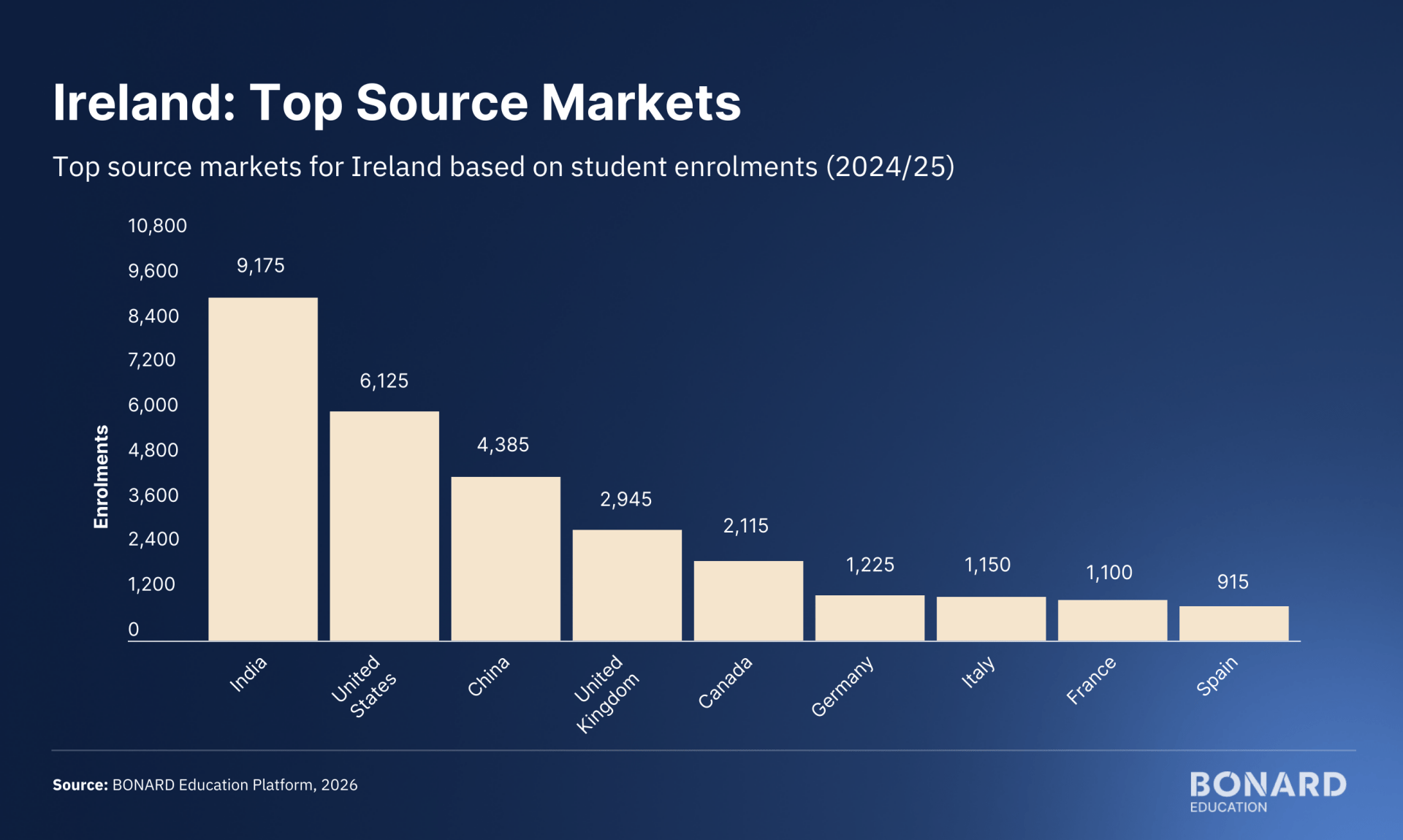
India, the US and China remain Ireland’s top source markets, creating both demand strength and concentration risk;
For student housing investors, Ireland’s student enrolment growth is a clear demand signal, but future opportunity will depend on where student growth aligns with accommodation shortages and delivery capacity.
Ireland’s student growth is becoming a housing demand signal
Ireland’s international education sector is thriving, but maintaining momentum will require strategic precision, not only from universities but also from the student housing market that supports them.
In the academic year 2024/25, publicly funded higher education institutions in Ireland reported 44,540 non-Irish domiciled enrolments, representing a 10.2% year-on-year increase. Non-EU students now account for the majority of this cohort, totalling 32,940 enrolments.
For student housing investors, this growth matters because international and mobile students are among the strongest drivers of accommodation demand. When enrolments rise faster than housing capacity, pressure builds across purpose-built student accommodation, private rentals and wider urban housing markets.
Ireland’s growth therefore should not be viewed only as an education-sector story. It is also a demand-side signal for student housing, particularly in cities where institutional expansion, international enrolment growth and limited accommodation availability converge.
Ireland is converting redirected global demand
BONARD Education Platform data indicates that Ireland’s higher education market is not only growing, but recovering faster than many competing study destinations.
After the 2020/21 contraction, university enrolments followed a steady upward trajectory, with the strongest gains recorded in the most recent academic cycles. This pattern reflects a system that is effectively converting redirected global demand.
Ireland’s international student share has reached 12.4%, above the OECD average of 7.4%. This positioning reflects a combination of stable student visa processing, clear post-study work pathways and strong alignment between education and labour market demand.
In a more risk-sensitive global student mobility environment, these factors increasingly outweigh brand or ranking alone. For student housing investors, they also improve demand visibility, a critical consideration when assessing new markets or underwriting accommodation schemes.
Ireland also shows an unusual source market profile.
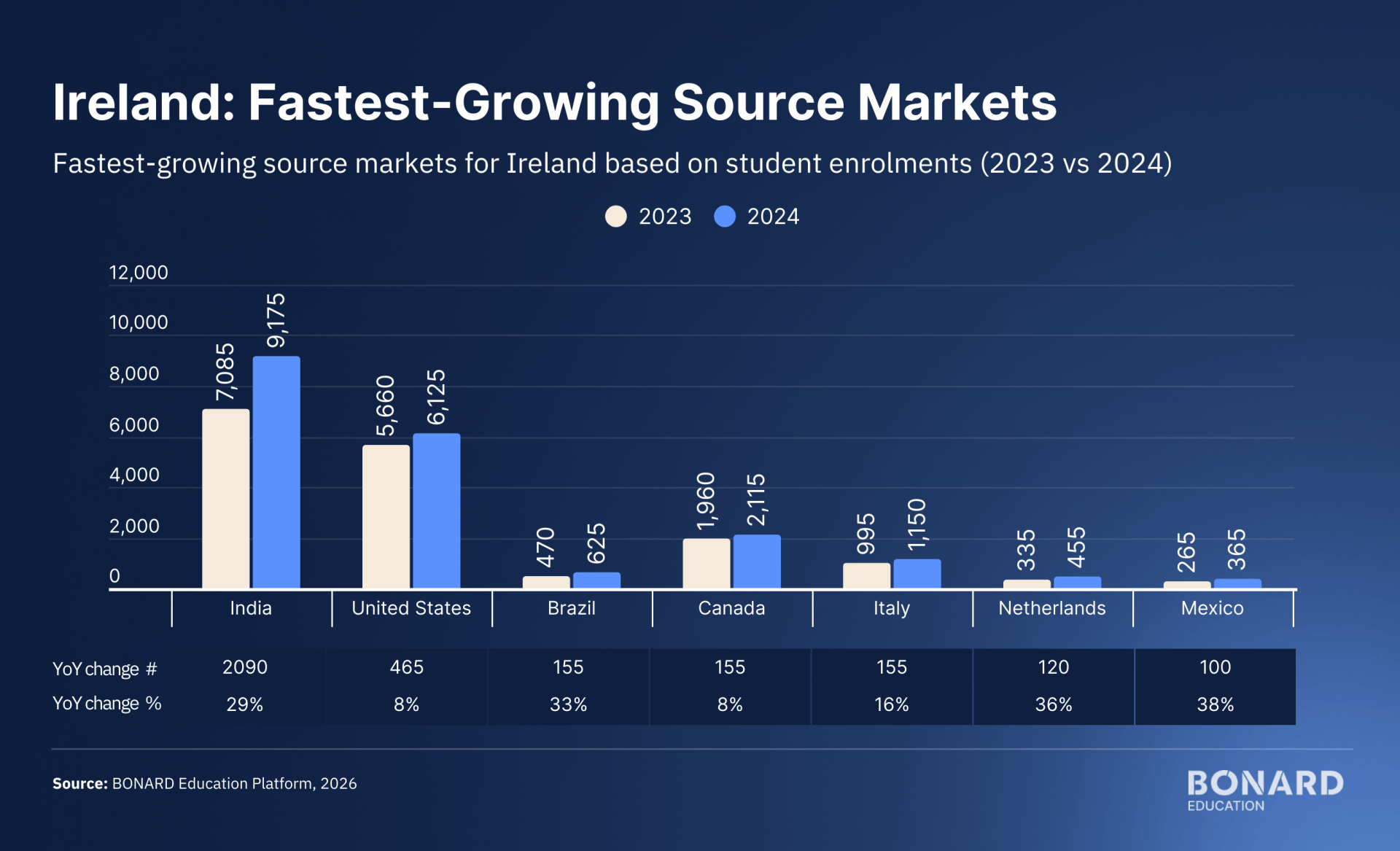
While many European study destinations rely heavily on Asia, Ireland attracts a significant share of students from North America. This diversification reduces exposure to single-region shocks and strengthens the resilience of accommodation demand.
Student housing capacity could become a constraint
Growth systems often fail not at peak demand, but when capacity, concentration and external conditions become misaligned.
For Ireland, one of the most important constraints is student housing capacity.
When student enrolments outpace onboarding, reputational and operational risks increase.
This is directly relevant to student housing stakeholders. Sustained student enrolment growth can support high occupancy and rental resilience, but only where the market can deliver the right product in the right locations.
Not all institutions, cities or regions have equal capacity to absorb growth. As a result, investors should look beyond national student enrolment figures and assess city-level student demand, housing shortages, pipeline activity and affordability conditions.
Source market concentration remains a risk
Ireland’s enrolment base remains heavily concentrated in three source markets: India, the United States and China.
This is not inherently a weakness, but it becomes a risk if future growth depends too heavily on a limited number of markets. Policy shifts, currency movements, visa conditions or changes in student preferences can quickly affect student recruitment pipelines.
For student housing investors, source market concentration matters because it affects the resilience of future occupancy. A diversified student base can reduce volatility, while overreliance on one or two countries can increase demand risk.
Early indicators such as student visa data, application-to-offer ratios and shifts in source market behaviour can signal changes 6–12 months before student enrolment impacts become visible.
Policy stability supports student housing demand
Ireland’s current growth is partly linked to policy tightening in other major study destinations.
Students are increasingly evaluating study options through affordability, visa certainty and post-study work opportunities.
Ireland’s work-and-stay proposition is therefore strategically important. Stamp 2 allows non-EEA students to work during their studies, while Stamp 1G provides eligible graduates with post-study work permission.
These policies help strengthen Ireland’s position as a study destination, particularly for students seeking a clearer return on investment. For the student housing market, this supports the depth and continuity of demand.
However, current momentum should be treated as conditional, not guaranteed. Any easing in competing study destinations, particularly Canada or the UK, could reabsorb part of the displaced demand.
ELT is an overlooked feeder for housing demand
Ireland’s English Language Education sector is often underestimated as a feeder for higher education and wider student accommodation demand.
BONARD Education’s Annual Report on ELT in Ireland 2024, developed in partnership with English Education Ireland, shows that Ireland welcomed 128,761 international ELT students in 2024, generating EUR 792 million in direct economic impact.
For universities, ELT can act as a progression pathway into higher education. For student housing stakeholders, it represents a broader mobility ecosystem that can support demand beyond traditional degree-seeking students.
In a more competitive and fragmented global mobility landscape, pathway, language and short-term study segments should not be ignored when assessing student demand and accommodation needs.
What should student housing investors monitor?
Ireland’s international student growth presents a positive demand outlook, but the investment case should be assessed through a city-level and capacity-led lens.
Key indicators for student housing investors include:
International and domestic mobile student growth by city;
Institution-level enrolment expansion and intake targets;
Source market diversification and concentration risk;
Student visa trends and post-study work policy stability;
PBSA supply, pipeline and provision rates;
Private rental market pressure and affordability;
Student preferences by level of study, nationality and budget;
ELT and pathway demand as feeder segments.
Tracking these indicators helps investors identify where enrolment growth is most likely to translate into accommodation pressure, occupancy resilience and long-term asset performance.
What does this mean for stakeholders?
Ireland’s current growth trajectory reflects a broader shift in global student mobility, from purely preference-driven destination choice towards more constraint-driven decision-making.
For student housing investors, the key takeaway is clear: demand is strengthening, but it is not evenly distributed. The opportunity will depend on where international student growth aligns with limited supply, affordability pressure and institutional capacity.
Ireland remains well-positioned, supported by strong international enrolment growth, stable policy conditions and a diversified demand base. However, accommodation capacity, source market concentration and external policy shifts will require ongoing monitoring.
Markets that can combine student growth with the right product, location and delivery strategy are likely to be best positioned to capture future demand.

“Ireland’s international student growth is a strong demand-side signal for student housing, but the opportunity is not national, it is city-specific. Investors need to understand where enrolment growth, accommodation shortages and delivery capacity intersect.”
Ivana Bartosik
International Education Director, BONARD
For a deeper understanding of student demand, enrolment trends and student housing market fundamentals, explore the BONARD Platform or follow BONARD Education for regular demand-side insights.

For tailored advice on evaluating student housing opportunities through the lens of student demand and mobility trends, contact Filip to explore how he can support your next acquisition or development strategy.


SUBSCRIBE TO STUDENT HOUSING INSIDER
Stay close to the student housing market
Subscribe to Student Housing Insider for a weekly update on student housing transactions, development pipeline, market trends and selected BONARD analysis.
Designed for investors, developers, operators, lenders and market participants tracking the student housing sector.