


Analysis: How Europe’s student housing is redefining room types
Our latest product development analysis looked at 4,461 privately-held assets across 12 biggest PBSA markets in Europe to quantify the evolution of PBSA room mix.
Europe’s student housing market is increasingly dominated by single-occupancy living, with studios emerging as the leading format.
If you are short on time:
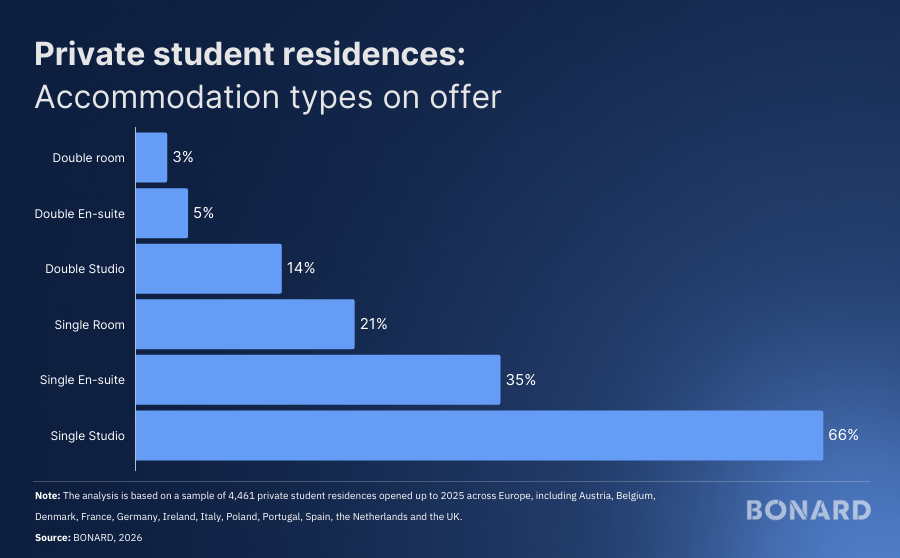
Single-occupancy studios are the most common room type in Europe, offered in 66% of private student residences, with France leading at 95% of properties;
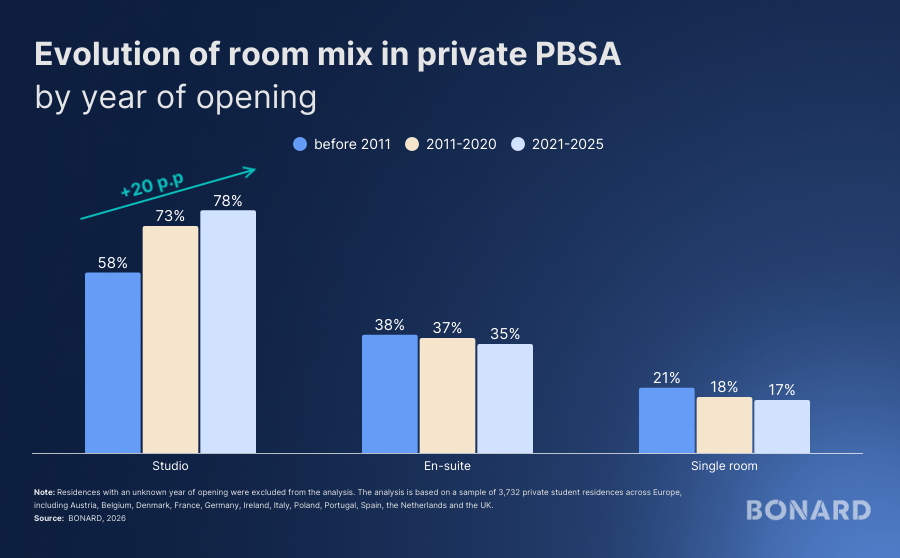
78% of PBSA schemes opened between 2021 and 2025 offer studios, up from 55% in pre-2011 schemes, reflecting a long-term repositioning of the product mix;
Studio growth is driven by student preferences and reinforced by developer benefits, including higher yields, stronger appeal to international students and lower operational complexity.
Single-occupancy accommodation dominates student residences
Single-occupancy accommodation now dominates private student residences across the analysed European markets, reflecting the growing value students place on privacy and independence.
Single studios are the most common room type, offered by 66% of private student residences. France leads this trend, with 95% of properties providing studios.
Single en-suite rooms represent the second most prevalent room type and are particularly dominant in Ireland, where they account for 71% of offerings. They are also widely established in the UK and Spain, representing 56% and 51% of market offerings, respectively.
Studios have become the standard in the most recent PBSA development wave
Over the past decade, the PBSA sector has steadily shifted towards studio-led development, while the offer of other room types has remained comparatively stable.
Among PBSA schemes delivered between 2021 and 2025, 78% include studios. This is 20 percentage points higher than developments completed before 2011.
Looking across regions, studios have historically been well established in Western Continental Europe. However, the most significant growth has been observed in Ireland (+61%) and Southern Europe, particularly Portugal (+53%), Italy (+38%) and Spain (+38%).
Why studios are gaining ground
The shift towards studio-led development reflects a structural change in student expectations. Students are placing greater value on independence, privacy and self-sufficiency, a trend reinforced by post-COVID lifestyle preferences.
From a development perspective, studios also offer clear structural advantages. They typically generate higher rental yields per unit, improving overall financial efficiency.
Studios are particularly attractive to international and postgraduate students, who often have higher purchasing power and stronger expectations around privacy. They can also reduce operational complexity by minimising friction in shared living environments and lowering reliance on communal facilities.
This evolution is contributing to the standardisation of PBSA as an asset class, with studios increasingly becoming a defining feature of modern student housing schemes.
Regional differences still matter
While studios have gained ground across Europe, the trend is not uniform across all markets.
In markets such as Poland, Italy and Portugal, single rooms remain as common as studios, suggesting that local affordability, market maturity and student preferences continue to shape room mix decisions.
This means that the shift towards studio-led development should not be interpreted as a one-size-fits-all strategy. Product mix still needs to reflect local demand, purchasing power, affordability pressures and the competitive landscape.
What does this mean for stakeholders?
These dynamics are reshaping the PBSA sector by driving greater standardisation and aligning student housing more closely with hospitality-led standards for privacy, design quality and amenities.
However, given rising affordability pressures, changes in the PBSA room mix will require ongoing monitoring.
Markets that can support studio-led schemes may offer stronger income potential, while more price-sensitive locations may still require a broader mix of room types.
“The shift towards studios shows that privacy is becoming a defining feature of modern student housing. But product mix still needs to be market-specific, especially as affordability pressures increase.”
Olha Kriukova
Real Estate Consultant, BONARD

For a deep understanding of room types, sizes, rents across 17,000 assets, explore the BONARD Platform.

For tailored advice on product development trends, contact Filip to explore how we help develop an appropriate room type mix.




SUBSCRIBE TO STUDENT HOUSING INSIDER
Stay close to the student housing market
Subscribe to Student Housing Insider for a weekly update on student housing transactions, development pipeline, market trends and selected BONARD analysis.
Designed for investors, developers, operators, lenders and market participants tracking the student housing sector.