


Analysis:
Italy’s PBSA market is building momentum, with a sizeable
pipeline ahead
Italy’s PBSA pipeline is entering a major expansion phase, with 139 assets expected to deliver
nearly 36,700 publicly disclosed beds. That is equivalent to over 50% of existing operational
stock across major student hubs.
With 75% of pipeline beds in private assets, institutional investors and specialist operators
are playing an increasingly central role.
If you are short on time:
The pipeline is geographically concentrated in Italy’s largest student hubs (Milan with
nearly 8,300 beds, Rome with nearly 4,600 beds, and Turin, Padua, and Bologna each with 3,500 – 4,500 beds).Based on expected opening year, the pipeline is strongly front-loaded. The largest delivery wave is expected in 2026 and 2027, with private assets accounting for the majority of beds coming to market.
Looking at operators and brands, CampusX, YUGO and Camplus stand out as the largest players in the disclosed pipeline by capacity. Their presence highlights the increasing institutionalisation of Italy’s PBSA sector, as larger specialist platforms continue to scale portfolios across major university cities.
Pipeline volumes signal a new growth phase for Italian PBSA
Italy’s PBSA pipeline remains substantial, with 139 assets currently in the pipeline, representing 36,664 publicly disclosed beds. This growth is being driven primarily by private capital. Private assets account for 75% of disclosed pipeline beds, underscoring the rising influence of institutional investors and specialist operators in shaping Italy’s next wave of student housing supply.
Italy’s leading PBSA markets are set for another major expansion
The operational stock vs. pipeline comparison highlights the continued concentration of PBSA growth in Italy’s established university hubs. Milan leads by a wide margin, both in current operational stock and future pipeline, with planned beds equal to 54% of its existing supply. This confirms Milan’s role as Italy’s most mature and liquid PBSA market, while still offering substantial room for further growth.
Among the other major markets, Bologna and Turin show the strongest relative expansion, with pipeline beds representing 58% and 50% of current operational stock, respectively. This indicates that both cities could experience a material increase in PBSA provision over the next development cycle. Rome’s pipeline is large in absolute terms but more moderate relative to its existing base.
Overall, the pipeline is not only adding scale but also deepening the role of Italy’s largest student cities as institutional PBSA markets.
A major private-sector delivery wave is expected in 2026
The delivery profile shows a clear near-term acceleration, particularly in the private pipeline. Private projects are expected to deliver around 7,775 beds in 2026, followed by another 5,488 beds in 2027, making these two years the most important supply-growth window. From 2028 onward, the pipeline thins considerably, with annual private deliveries falling below 2,000 beds.
Italy is approaching a major PBSA delivery wave, but the pipeline becomes significantly less visible beyond 2027. This may indicate either a genuine slowdown in new project creation or simply limited visibility on later-stage schemes, as many longer-term projects may still be undisclosed or not yet formally announced.
Private capital is reshaping Italy’s student housing supply
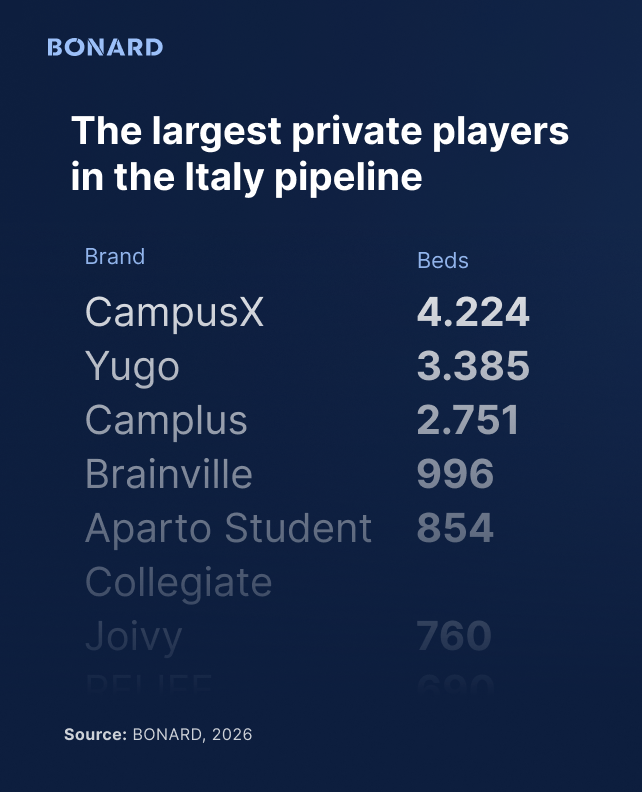
The disclosed pipeline highlights the growing role of established PBSA operators in Italy, with brands such as CampusX, YUGO and Camplus among the most visible names in future supply. Their presence points to a more professionalised and institutionally managed market, where new developments are increasingly supported by experienced operators with recognised brands, established operating models and a clearer student-facing proposition.
What does this mean for stakeholders?
For investors, Italy offers a compelling PBSA growth story: demand remains structurally supported by large university populations, limited modern student accommodation supply, and growing internationalisation in key cities. The dominance of private-sector beds in the pipeline suggests that institutional capital is increasingly confident in the sector’s long-term fundamentals.
For city stakeholders and universities, the pipeline represents an opportunity to improve student accommodation availability and support international student attraction. At the same time, the concentration of new private supply in selected cities may widen the gap between well‑supplied PBSA markets and cities where students remain heavily dependent on the private rental sector.

"Italy’s PBSA sector is entering a decisive growth phase, with a sizeable private-sector pipeline set to reshape student housing supply across the country’s largest university hubs. As institutional investors and specialist operators expand their presence, the market is moving toward greater scale, maturity and professionalisation"
Ina Durcekova
Real Estate Consultant, BONARD
For a deeper understanding of student housing demand, supply gaps, development pipelines and market-level provision rates, explore the BONARD Platform or learn more about how BONARD supports market selection and investment strategy.

For tailored advice on evaluating student housing opportunities in Germany and Europe, contact Filip to explore how he can support your next acquisition or development strategy.



SUBSCRIBE TO STUDENT HOUSING INSIDER
Stay close to the student housing market
Subscribe to Student Housing Insider for a weekly update on student housing transactions, development pipeline, market trends and selected BONARD analysis.
Designed for investors, developers, operators, lenders and market participants tracking the student housing sector.