


If you are short on time:
PBSA rents rose 20–30% over roughly five years, well ahead of the slower rise in student disposable income.
Willingness to live in PBSA remains high. Above 90% in Coventry, Nottingham and Birmingham, but strong demand does not automatically convert automatically into occupancy.
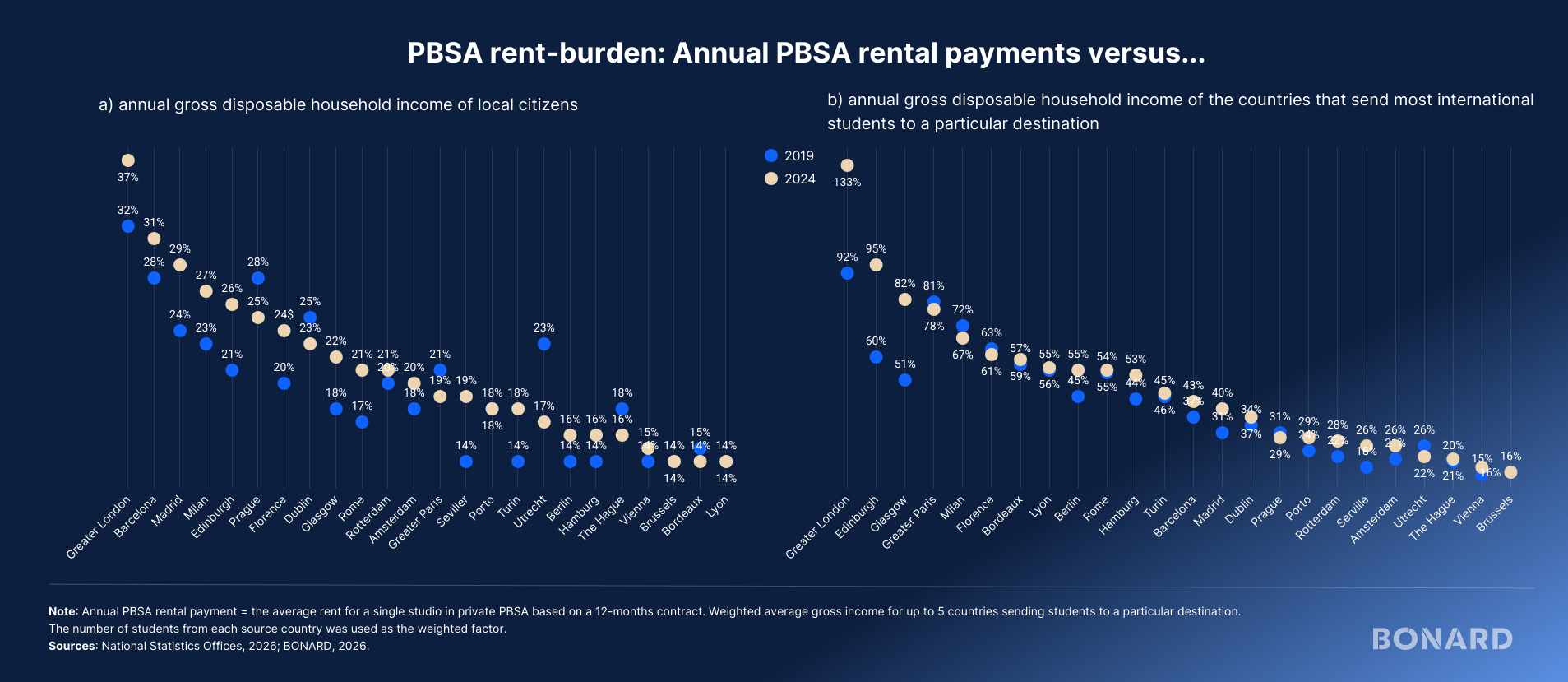
BONARD's PBSA rent‑burden metric shows that PBSA affordability in the UK has deteriorated more sharply than in major European student markets between 2019 and 2024.
The historical inflation‑to‑rent pass‑through may be reaching a turning point, limiting operators' ability to keep raising rents at the same pace.
For years, rising PBSA rents were read as a sign of strength, evidence of deep demand and pricing power. BONARD’s UK PBSA Report 2026 suggests that this relationship is reaching its limit.
Affordability has deteriorated to the point where it now actively constrains pricing, absorption and leasing risk, and the pressure is becoming a sector‑wide issue rather than a localised concern.
Willingness is not the same as ability
One of the report's key distinctions emerges from its Net Provision Rate Benchmark. The benchmark measures how many mobile students are willing to live in PBSA, and in cities like Coventry, Nottingham and Birmingham that figure exceeds 90%, confirming PBSA as a mainstream rather than niche choice.
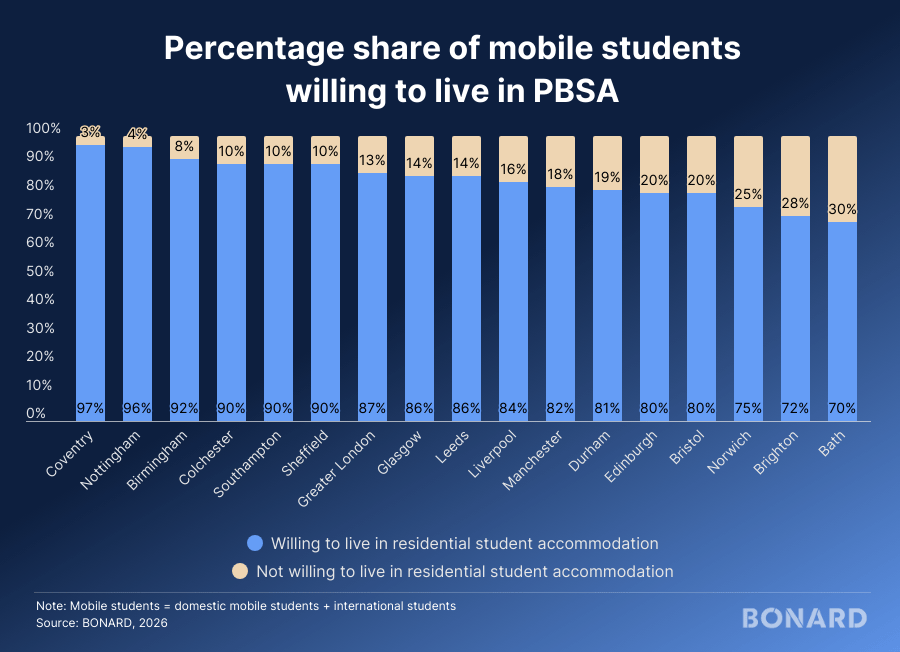
But willingness and affordability are different variables. Rising rents have widened the gap between what students would prefer and what they can realistically pay, meaning high PBSA propensity no longer converts automatically into occupancy or absorption.
Birmingham illustrates the mechanism: many local students now commute rather than live in the city, a response to cost rather than a lack of appetite for the product. Even Greater London, with an 87% willingness benchmark, shows the same pattern, while many students would prefer to live in PBSA, rising accommodation costs increasingly push students towards alternative accommodation options.
A rent‑burden lens on the whole sector
To track the trend consistently, BONARD developed a PBSA rent‑burden metric. It compares annual PBSA rental payments with yearly gross disposable household income.
It is a trend indicator rather than a precise budget for any individual student, but the direction is clear: between 2019 and 2024, the rent‑burden rose across several markets, driven by rental growth, slower income progression and, for some international students, currency depreciation.
The report that PBSA affordability has deteriorated more sharply in the UK than in major European student markets.
The rent‑inflation relationship reinforces the point. PBSA rents have historically tracked inflation with a roughly one‑year lag, and that correlation remains strong. But the report flags that the current cycle could mark a turning point. Even though the correlation with lagged inflation remains strong, affordability struggles, softer booking behaviour, and more rigid pricing policies may limit operators’ ability to keep pushing rents at the same pace.
The pricing discipline this demands
For investors and operators, affordability moves from footnote to constraint. Product quality still matters, but the ability to convert better amenities into higher rents is increasingly capped by what a local market will bear.
The report's warning is against overcapitalised schemes that exceed local willingness to pay. Well‑located, appropriately priced assets capture demand most effectively; premium products priced beyond the market's ceiling face greater leasing risk.
The investment question has quietly inverted. It is no longer only "how much rent can this asset command?" but "how much rent can this market actually absorb?".

REQUEST FORM
Request your copy of the
UK PBSA Report 2026
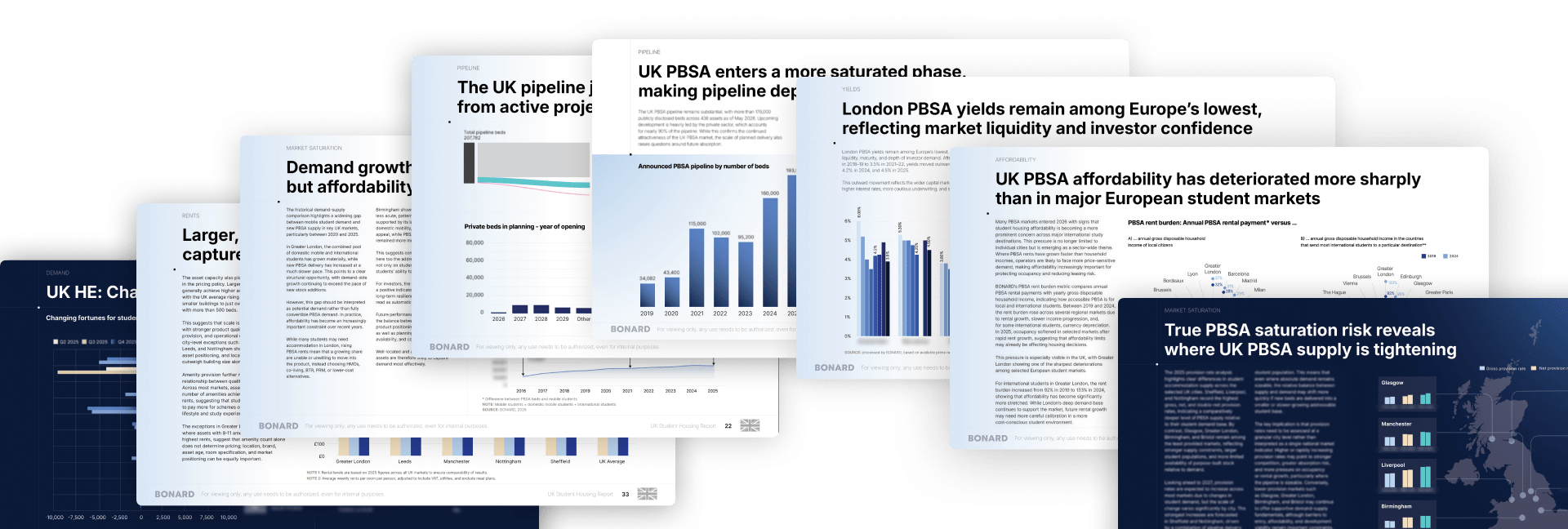
Prepared by BONARD’s team of experts in student housing, the latest edition of the report tracks key data points, including demand, market saturation levels, occupancy rates, rent levels, transactions, yields, construction pipelines, and portfolios.

Explore the student housing market in greater depth on the BONARD Platform, or contact Filipfor tailored guidance on your next acquisition or development strategy.



SUBSCRIBE TO STUDENT HOUSING INSIDER
Stay close to the student housing market
Subscribe to Student Housing Insider for a weekly update on student housing transactions, development pipeline, market trends and selected BONARD analysis.
Designed for investors, developers, operators, lenders and market participants tracking the student housing sector.