


If you are short on time:
Rome is adding student housing at an increasingly rapid pace, with almost all recent and planned supply growth being driven by the private sector.
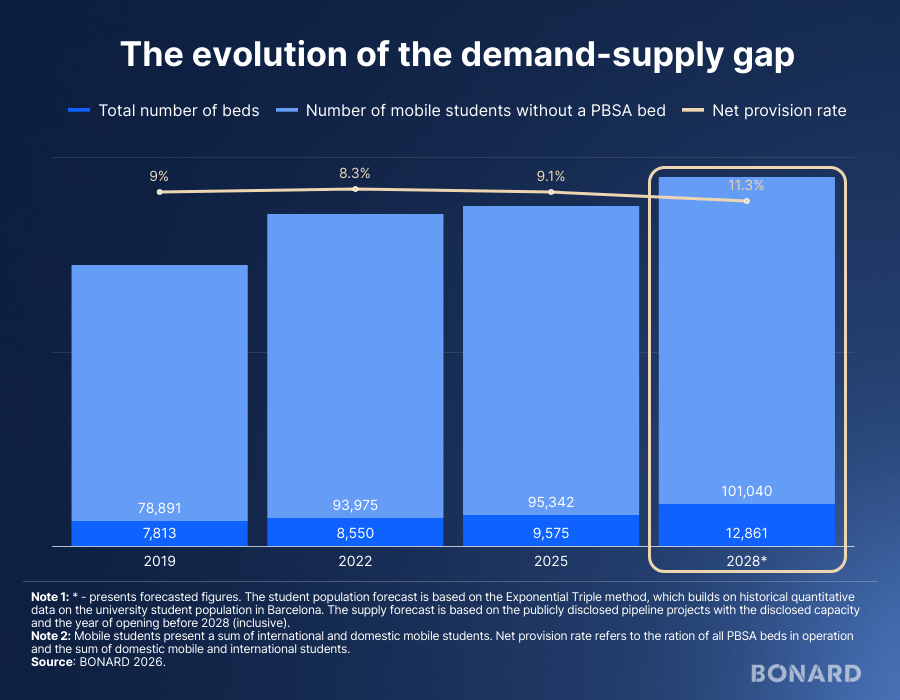
Demand is expanding at the same time: even with the current pipeline delivered, the net provision rate is expected to increase only from 9.1% in 2025 to 11.3% by 2028, leaving the vast majority of mobile students outside dedicated student accommodation.
This persistent shortage increasingly links PBSA with Rome’s wider housing challenge, helping to explain why both policymakers and institutional investors are approaching student accommodation as part of broader living and affordability strategies.
Rome is emerging as one of Italy’s most dynamic student housing markets, supported by a large and growing mobile student population and increasing institutional interest. While new PBSA development is accelerating, demand continues to outpace supply, leaving the market structurally undersupplied.
At the same time, student housing is becoming more closely linked to Italy’s broader housing agenda: the government’s new national housing plan targets a substantial expansion of affordable supply, while investors such as Mubadala are backing strategies that combine PBSA with affordable and market‑rate housing. This positions PBSA not only as a response to student demand, but increasingly as part ofthe wider solution to rental‑market pressure in major Italian cities.
The private sector is reshaping Rome’s student housing market
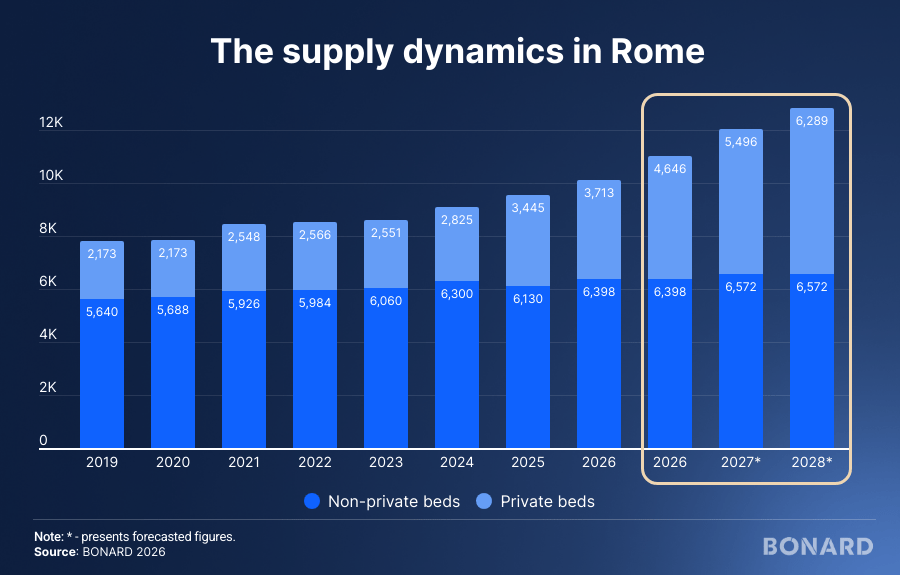
Rome’s student housing market has entered a period of accelerated expansion, increasingly driven by private operators. While non‑private supply has been the main source of student accommodation in the past, it has remained broadly stable.
The majority of recent and planned growth comes from the private sector, with total PBSA capacity expected to increase significantly through 2028, supported by a robust announced pipeline.
Rome is adding beds, but most students remain reliant on the wider rental market
The ongoing expansion of Rome’s PBSA market is being matched by continued growth in the mobile student population, limiting the extent to which new supply can materially improve overall provision. Even if the current pipeline is delivered in full, the net provision rate is expected to rise only modestly, from 9.1% in 2025 to 11.3% by 2028. Rome is therefore adding beds, but not fast enough to fundamentally rebalance the market.
The vast majority of mobile students will continue to rely on the conventional rental sector, leaving student demand directly exposed to the same affordability and availability pressures affecting the wider housing market.
This makes Rome’s student accommodation shortage increasingly difficult to view as a standalone PBSA issue. It forms part of a much broader housing challenge, particularly for groups that depend on rental accommodation and have limited access to mainstream housing. Italy’s new Piano Casa explicitly recognises students, alongside young people and mobile workers, as being among the groups struggling to access housing on the open market, with the programme seeking to expand affordable supply through the reuse of existing buildings, social housing and urban regeneration.
In Rome, increasing dedicated student provision could therefore have a twofold effect: accommodating a greater share of the growing student population while reducing some of the pressure that students place on the city’s conventional rental stock.
Institutional capital is beginning to reflect this convergence between student housing and the wider residential market. Recent investment strategies increasingly position PBSA alongside affordable and conventional rental housing rather than treating it as an isolated asset class; Mubadala’s 2026 investment strategy, for example, targets both PBSA and affordable housing as part of a broader living‑sector initiative.
Against this backdrop, Rome’s low provision rate, expanding student population and private‑sector‑led pipeline point to a market where the opportunity extends beyond simply delivering more student beds: PBSA is increasingly becoming one component of the response to the city’s wider shortage of suitable, accessible rental housing.
What does this mean for stakeholders?
Rome’s student housing market is entering a new phase of private‑sector‑led growth, but supply is still expanding more slowly than underlying demand. Even with the current pipeline delivered, the net provision rate is expected to remain low, leaving most mobile students reliant on the wider rental market.
For stakeholders, the opportunity remains significant, but future success will depend increasingly on location, connectivity, affordability and the ability to deliver the right product for each university catchment area.

"Constructing new student beds offers a dual advantage by housing learners while simultaneously relieving strain on Rome’s wider housing sector. Ultimately, industry stakeholders must carefully navigate this evolving landscape by prioritizing strategic locations, strong connectivity, and affordability to achieve long‑term success."
Ina Durcekova
Real Estate Consultant, BONARD

Explore student housing market in greater depth on theBONARD Platform, or contact Filip for tailored guidance on your next acquisition or development strategy.



SUBSCRIBE TO STUDENT HOUSING INSIDER
Stay close to the student housing market
Subscribe to Student Housing Insider for a weekly update on student housing transactions, development pipeline, market trends and selected BONARD analysis.
Designed for investors, developers, operators, lenders and market participants tracking the student housing sector.