


Analysis:
Vancouver's PBSA landscape: a new chapter for private development
Vancouver’s student housing is transitioning from a university‑led model toward private sector expansion, as nearly 3,000 pipeline beds are set to increase the private market share from 11% to 20% by 2031.
If you are short on time:
Vancouver's net provision rate currently stands at 22%, above the Canadian average. However, private accommodation accounts for just 11% of total student housing stock, the lowest share among the country's key student markets.
Student housing provision has traditionally been dominated by universities, particularly the University of British Columbia, while high development costs and competition from other residential uses have constrained private activity.
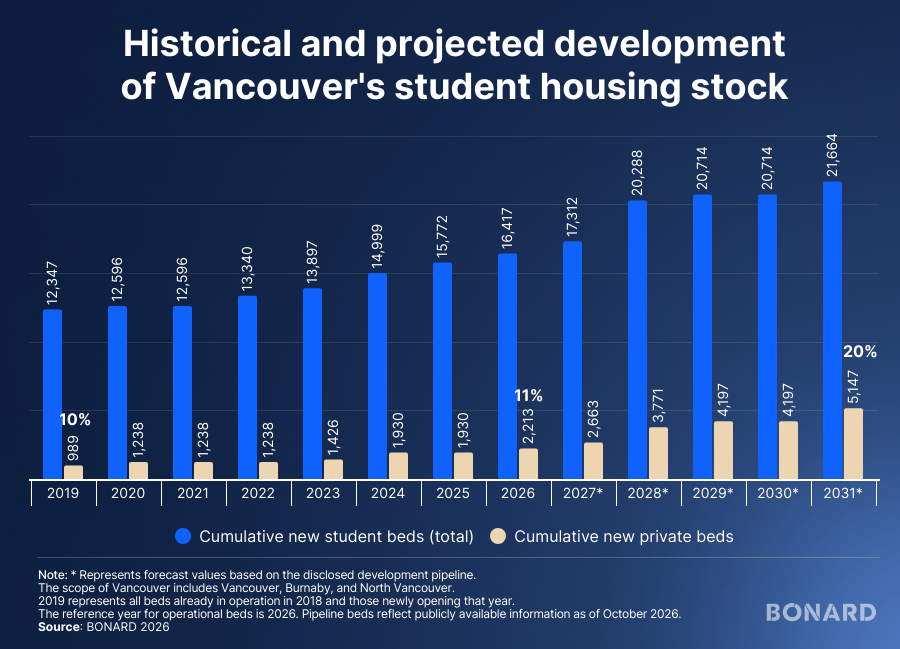
Nearly 3000 private beds are in the development pipeline, potentially increasing the sector's share within Vancouver's total PBSA stock to 20% by 2031.
Although international enrolment is expected to decline following federal study permit restrictions, continued domestic enrolment growth and Vancouver's sizeable international student population are expected to support a substantial student housing demand base.
As Canada's third‑largest student hub, Metro Vancouver benefits from a substantial student demand base supported by one of the country's highest shares of international students and a growing domestic student population. Yet, despite its significant student housing stock and a provision rate above that of many Canadian university cities, private development has historically remained limited, with university‑operated residences dominating the market.
However, this landscape is set to change. With nearly 3000 private beds in the developmentpipeline, including approximately 1,400 beds planned by Forum Asset Management, Vancouver is entering a new phase of private investment activity that could significantly reshape its student accommodation market.
One bed for every five students in Vancouver
Vancouver was home to 129,862 higher education students in the 2024/25 academic year, making it Canada's third‑largest student hub after Toronto and Montreal. Of these, 91,030 were mobile students, including 37,472 international students, representing a substantial demand base for purpose-built student accommodation (PBSA).
The city currently offers 19,792 PBSA beds, translating into a net provision rate of 22% (i.e. the ratio of dedicated student beds to domestic mobile and international students combined) or approximately one bed for every five mobile students. Although dedicated accommodation covers only a fraction of the city's mobile student population, Vancouver's provision rate is considerably higher than Toronto's 13%, Montreal's 9%, and the 17% average across major Canadian student hubs.
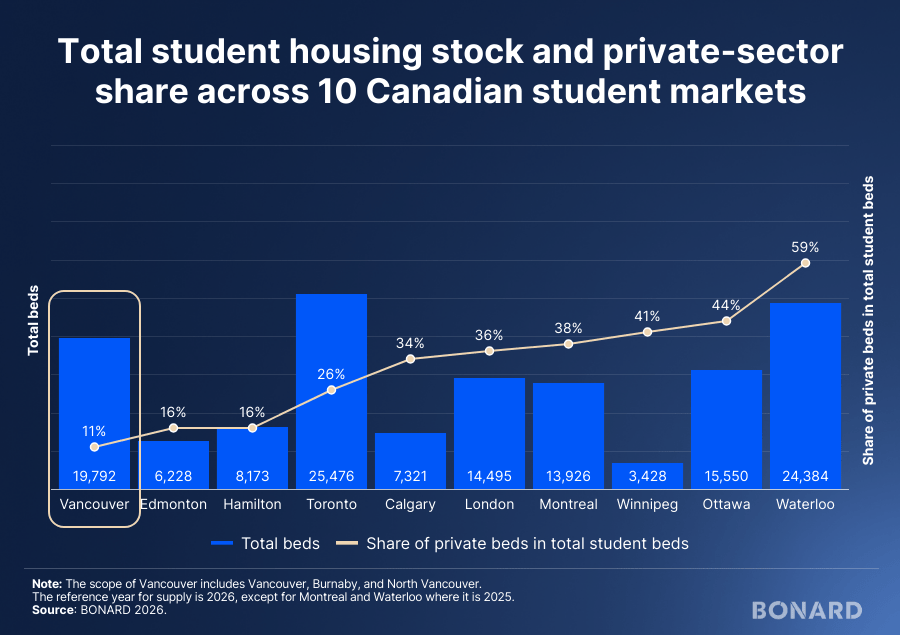
Despite Vancouver's substantial student housing stock, the private sector remains relatively underdeveloped. Currently, only 2,213 privately operated beds are available across 14 residences, accounting for a mere 11% of the city's total PBSA stock, the lowest share among the ten key Canadian student markets analysed. By comparison, private accommodation represents 26% of total stock in Toronto and 38% in Montreal. Even smaller student housing markets, such as Edmonton and Hamilton, have a higher private‑sector share of approximately 17% despite offering considerably fewer PBSA beds, at around 6,200 and 8,200, respectively.
Vancouver's distinctive market structure is largely characterised by strong university‑led provision, particularly by the University of British Columbia (UBC), which operates more than 13,600 beds across 18 residences. UBC has historically played a prominent role in expanding the city's student accommodation capacity, with its Campus Vision 2050 initiative aiming to deliver at least 3,300 net‑new student beds alongside approximately 1,000 replacement beds. Meanwhile, private investment has faced significant barriers including high land, material and labour costs, planning and regulatory constraints, limited institutional capital, and a relatively small pool of specialised operators.
Despite these structural barriers, growing investor interest and an expanding development pipeline indicate that Vancouver's traditionally university‑led accommodation landscape is beginning to evolve.
The incoming surge in Vancouver PBSA
The sector's share of total student housing stock remained largely unchanged between 2019 and 2026, increasing only marginally from 10% to 11%, despite continued growth in overall bed supply. However, this trend is set to shift considerably in the coming years, with nearly 3,000 private beds in the development pipeline expected to drive the sector's share to 20% by 2031.
This would represent a significant acceleration in private development, with private supply expanding considerably faster than the city's overall student housing stock.
Forum Asset Management, the largest PBSA owner in Canada, is a major contributor to the upcoming private supply, with approximately 1,400 beds planned under its ALMA brand. These beds are expected to be delivered across two developments in Burnaby and North Vancouver, scheduled for completion in 2029 and 2031, respectively.
Another prominent player, GEC Living by Global Education Communities, is planning two residences in Vancouver with a combined capacity of approximately 1,100 beds. One of these, the 450‑bed GEC Oakridge development is already under construction, with completion expected in 2027.
This shift marks a notable departure from previous years, when private development activity remained relatively subdued.
What does this mean for stakeholders?
Taken together, Vancouver's emerging private PBSA pipeline signals a gradual shift away from its historically university‑dominated accommodation model, but the changing demand outlook remains an important consideration. With federal caps on international study permits introduced in 2024 and continuing into 2026, alongside visa processing delays and ongoing policy uncertainty, international enrolment is expected to contract in the near term. Nevertheless, Vancouver's substantial existing international student population and continued growth in domestic enrolment are expected to underpin sizeable demand for student accommodation.
Although high development costs and short‑term uncertainty surrounding international enrolment remain important considerations, Vancouver currently offers growing opportunities for private developers and institutional capital to enter a major student market particularly through strategically located projects and university partnerships.
"Despite short‑term policy shifts, Vancouver’s student housing is entering a new phase of development. Its gradual shift away from a historically university‑dominated model is being driven by an expanding private PBSA development pipeline."
Kata Horvath
Real Estate Consultant, BONARD

Explore student housing market in greater depth on theBONARD Platform, or contact Filip for tailored guidance on your next acquisition or development strategy.



SUBSCRIBE TO STUDENT HOUSING INSIDER
Stay close to the student housing market
Subscribe to Student Housing Insider for a weekly update on student housing transactions, development pipeline, market trends and selected BONARD analysis.
Designed for investors, developers, operators, lenders and market participants tracking the student housing sector.