


Analysis: International student mobility across European markets
Educational institutions across Europe continue to attract international students, reshaping demand patterns and reinforcing the role of student mobility in higher education.
As demand accelerates and PBSA occupancy reaches 96% in 2025, supply constraints are strengthening the long-term investment case for student housing.
If you are short on time:
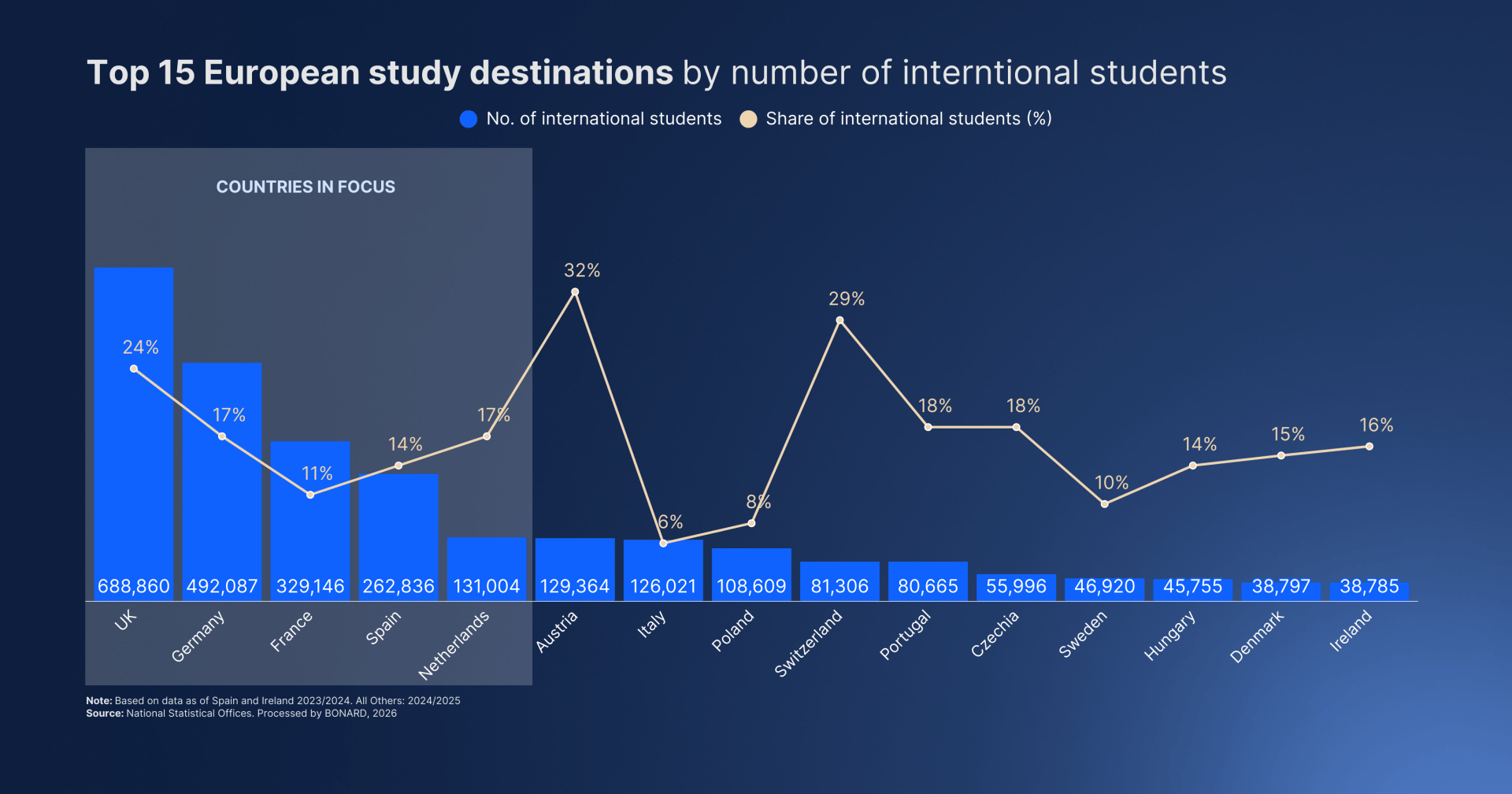
UK and Germany capture over 40% of international student intake across top European markets, largely driven by India and China;
High-growth English-taught hubs include Germany, France and Italy, supported by the rapid expansion of programmes;
Austria and Switzerland rely heavily on international students, while Germany and the Netherlands balance scale and diversification.
Foreign share extremes: From robust demand to upside plays
International student mobility across Europe continues to accelerate, with demand increasingly concentrated in a limited number of destination markets.
The UK and Germany dominate in absolute terms, accounting for over 40% of foreign student intake across major European markets, primarily driven by inflows from India and China.
At the same time, markets such as Austria and Switzerland show a significantly higher relative reliance on international students, making them more exposed to potential shifts in global mobility trends.
In contrast, Germany and the Netherlands combine scale with diversification, positioning themselves as more resilient and balanced higher education hubs.
These dynamics underscore robust demand drivers for PBSA in high-share markets, whereas low-share countries must prioritise international student growth to remain competitive.
Global hubs rising: UK, Spain, Netherlands surge past the pack
The expansion of English-taught programmes has become a key driver of international student growth across Europe.
Germany has reinforced its position as a leading international student hub, with online English-taught programme offerings expanding sixfold between 2019 and 2024. France and Italy have also recorded strong growth in on-campus English-taught provision.
Meanwhile, the UK, Spain and the Netherlands have achieved substantial growth in international student enrolments over the past five academic years, further strengthening their positions as global higher education destinations.
What does this mean for stakeholders?
Rising international student mobility continues to reinforce strong demand fundamentals for student housing across Europe.
High occupancy levels, sustained demand in key destination markets, and increasing diversification across emerging hubs are driving continued investor interest in the sector.
At the same time, supply constraints in high-demand cities are creating sustained pressure on accommodation markets, positioning student housing as one of the most competitive segments within the broader real estate landscape.
For investors and operators, this reinforces a clear trend: international student mobility is not only shaping demand, but increasingly defining where and how capital is deployed across European student housing markets.

“International student mobility is no longer just a demand driver. It is increasingly determining which markets outperform and attract capital.”
Andriy Semenov
Senior Real Estate Consultant, BONARD
For a deeper understanding of the European student housing market, including current supply, pipeline and provision rates, explore the BONARD Platform or access the webinar on this topic:

For tailored advice on evaluating investment opportunities across Europe, contact Filip to explore how he can support your next acquisition or development strategy.



SUBSCRIBE TO STUDENT HOUSING INSIDER
Stay close to the student housing market
Subscribe to Student Housing Insider for a weekly update on student housing transactions, development pipeline, market trends and selected BONARD analysis.
Designed for investors, developers, operators, lenders and market participants tracking the student housing sector.