


If you are short on time:
Madrid ranks as Europe’s third-largest student market, with international students accounting for 17% of the total population;
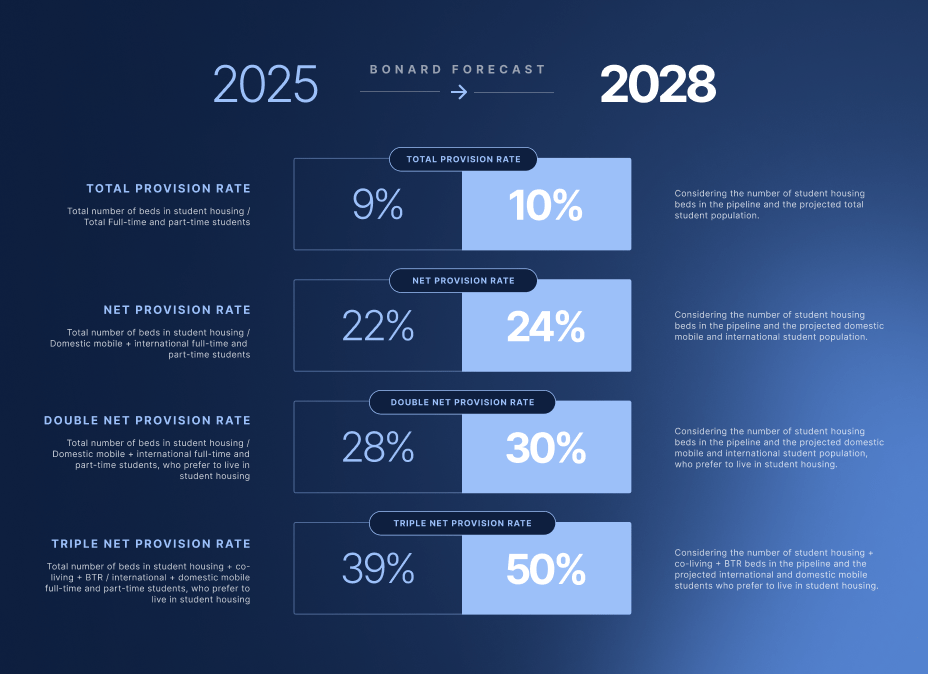
Net provision rate stands at 22%, leaving a shortfall of more than 60,000 beds;
Pipeline activity remains strong, with 18 projects expected to add over 4,600 beds.
Demand strength continues to outpace supply, driving investment
Madrid combines strong academic positioning with a growing international student base, reinforcing long-term demand for professionally managed student housing.
The city remains heavily reliant on privately-owned rental stock, with limited penetration of purpose-built student accommodation. This creates a persistent gap between demand and suitable housing supply.
Madrid’s growing appeal among investors has already translated into a number of notable transactions in 2026.
In January, Hines bought a 300-bed residence for €36 million. In April, Student Experience secured the tender for the development of a 600-bed student residence. Both assets are situated in Madrid’s Móstoles district, highlighting the area’s growing appeal as an important student housing hub.
Even after accounting for alternatives, supply meets only half of demand
Our modelling recognises that students do not dwell within a single accommodation segment but form part of a broader residential ecosystem. Their housing choices span private rentals, BTR schemes, co-living concepts, and PBSA.
In Madrid, the current net PBSA provision rate stands at 22%. When isolating only students actively seeking PBSA, this increases to 28%. Including co-living and BTR raises provision to 39%.
Looking ahead to 2028, the situation is not expected to change significantly. The shortfall of student accommodation will remain substantial, highlighting ongoing opportunities for targeted development in the area.
Co-living and flex-living as a student housing competition
Supported by strong demographic fundamentals and rising demand for flexible, community-oriented housing, Madrid’s co-living sector continues to expand.
The market currently includes 86 residences and nearly 8,800 beds, with approximately 45% of the beds present student-friendly accommodation, competing with the PBSA market.
What does this mean for stakeholders?
Despite increasing development activity, Madrid remains structurally undersupplied. The scale of the shortfall suggests that new supply can be absorbed across multiple accommodation formats without oversupply risk.
Importantly, the imbalance is not segment-specific but systemic, reinforcing a long-term investment case rather than a short-term opportunity.
As the market continues to mature, investors and developers who can deliver high-quality, well-located, and operationally efficient assets will be best positioned to capture this growing opportunity.

“Madrid highlights a broader trend. Even diversified student housing ecosystems are no longer sufficient to absorb growing student demand.”
Ina Durcekova
Real Estate Consultant, BONARD
For a deeper understanding of Spain’s student housing market, including current supply, pipeline and provision rates, explore the BONARD Platform or access webinar on this topic:



SUBSCRIBE TO STUDENT HOUSING INSIDER
Stay close to the student housing market
Subscribe to Student Housing Insider for a weekly update on student housing transactions, development pipeline, market trends and selected BONARD analysis.
Designed for investors, developers, operators, lenders and market participants tracking the student housing sector.