


Analysis: Student housing remains heavily undersupplied
The rising number of students across key markets has outpaced the delivery of student housing, resulting in a persistent and structural shortage of beds.
Even with active development pipelines, most cities remain below long-term saturation levels, meaning that significant additional capacity could be absorbed without oversupply risk.
If you are short on time:
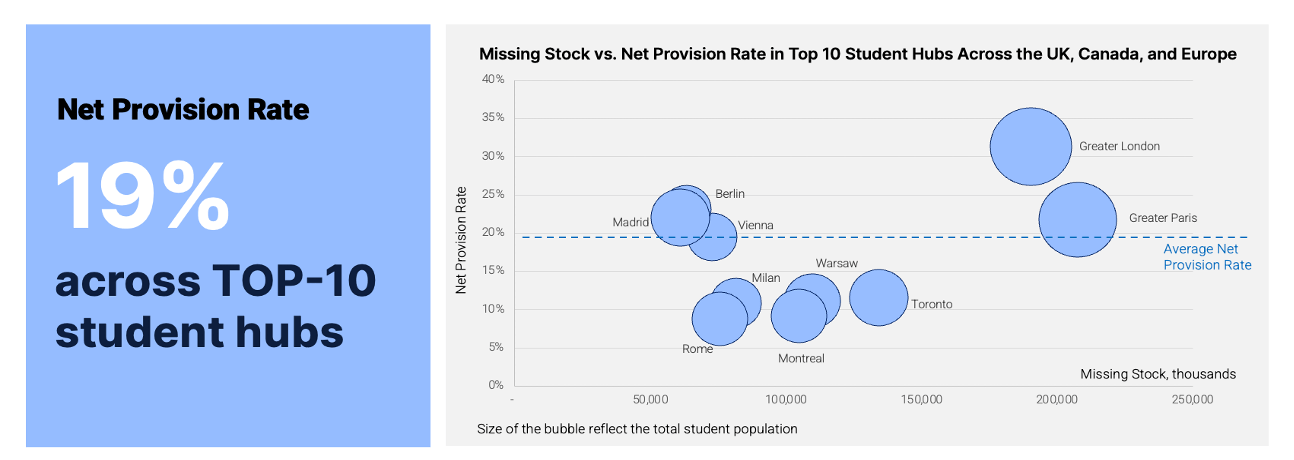
19% is the average net provision rate across the top-10 student hubs screened in Europe and Canada;
Greater London reaches 31%, leaving a shortfall of more than 190,000 beds;
Among major European markets, Rome remains the most undersupplied, with provision below 10% and a deficit of around 75,000 beds.
Student growth outpaces accommodation supply across Europe
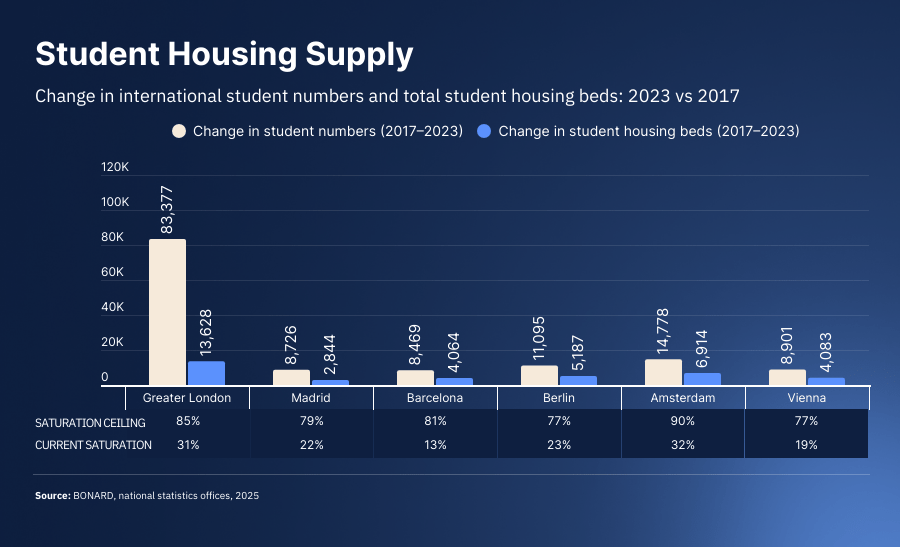
Growth in student numbers, particularly driven by international student demand, continues to exceed the delivery of new student housing supply across major European markets.
While cities such as London and Amsterdam have added significant volumes of new beds over the past six years, supply expansion has not kept pace with the increase in student populations. This dynamic is reinforcing pressure on private rental markets and contributing to affordability challenges in key urban centres.
Structural imbalance creates a sustained development opportunity
Across the analysed markets, the comparison between student demand and available student housing supply highlights a clear and persistent imbalance.
Even in a mature market such as Greater London, current provision meets only 31% of demand, leaving a deficit of more than 190,000 beds. In cities such as Rome and Montreal, where provision remains below 10%, shortages reach approximately 75,000 and 81,000 beds, respectively.
Notably, among the largest European student destination countries, Italy stands out as the most undersupplied market, reflecting consistently low saturation levels across its major university cities.
What does this mean for stakeholders?
Despite higher interest rates and rising construction costs, student housing continues to attract strong investor interest. The sector benefits from structurally high occupancy levels and relatively stable, recurring rental growth.
Importantly, the current supply-demand imbalance is not cyclical but structural. This suggests that new development can be absorbed across most major markets without materially increasing oversupply risk in the medium term.
As a result, student housing remains one of the most competitive segments within the broader residential real estate landscape, particularly for investors seeking income resilience and exposure to long-term demographic trends.

“For investors, the story is clear: undersupply in student housing is not a timing opportunity, but a structural feature of the market.”
Andriy Semenov
Senior Real Estate Consultant, BONARD
CONTACT FORM
Contact us
Find out how we can cater to your specific needs. We look forward to assisting you further and explaining how our services can benefit you.
⠀
⠀⠀⠀