


Analysis: Poland’s PBSA market gap: Strong development potential amid affordability pressures
Poland stands out as one of Central and Eastern Europe’s most attractive student housing markets, supported by a large and geographically diversified student base.
Low PBSA provision and a limited development pipeline create substantial opportunity, but affordability pressures mean that the right product, pricing and room mix will be essential.
If you are short on time:
Poland stands out as one of Central and Eastern Europe’s highest-potential student housing markets, supported by its scale and depth of demand across several major higher-education hubs;
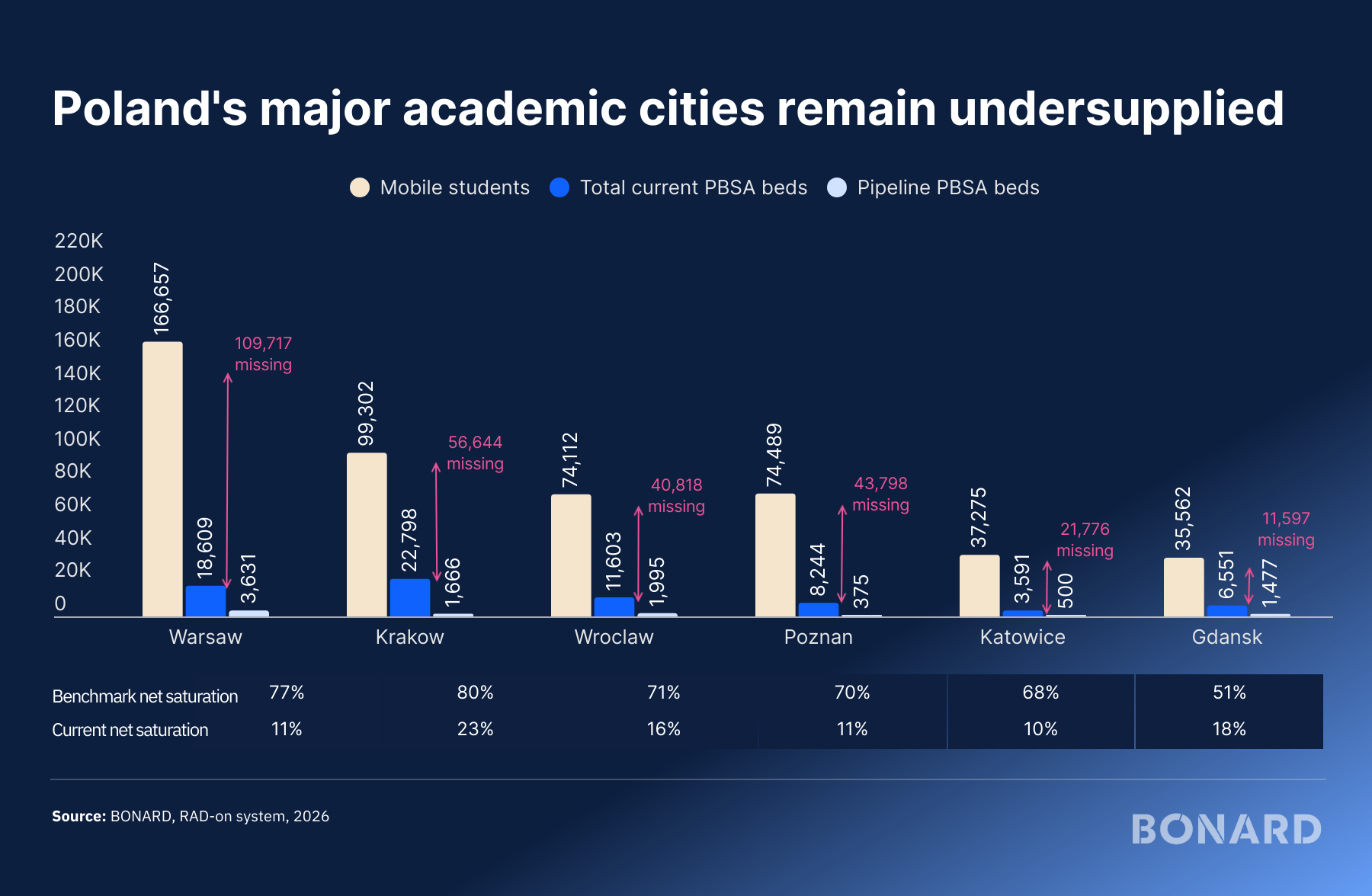
More than 280,000 PBSA beds are estimated to be missing across the selected major Polish cities, while the development pipeline remains constrained;
Warsaw, Krakow, Wroclaw and Poznan are the core investment markets, with a combined student population of more than 601,000 and around 415,000 mobile students;
Affordability is the central constraint, making product format, room mix and rental strategy critical to future performance.
Poland combines scale, mobile demand and low PBSA provision
Poland’s eight major higher-education study destinations — Warsaw, Krakow, Wroclaw, Poznan, Tricity, Katowice, Lodz and Lublin — have a combined student population of around 860,000.
Approximately 67% of these students are mobile, meaning they come from abroad or relocate from elsewhere in Poland and therefore represent the core demand base for student accommodation.
860k
Total Students
67%
Mobile students
280k+
Bed Shortfall
Warsaw, Krakow, Wroclaw and Poznan account for around 70% of the total student population and 72% of mobile students across the eight major study destinations.
Together, these four cities host more than 601,000 students, including approximately 415,000 mobile students. Their size, internationalisation and limited dedicated supply make them the primary focus of investor interest.
Poland stands out as a high-potential market in Central and Eastern Europe
Poland’s major academic hubs combine large mobile student populations with low PBSA provision rates, creating some of the largest student housing supply gaps in Central and Eastern Europe.
The market’s investment appeal is reinforced by the relative immaturity of its private PBSA sector. Private stock represents around 16% of total student housing provision in Poland, compared with an average of approximately 30% across 23 European countries.
This suggests significant room for institutional growth, particularly in cities where mobile student demand is already well established but professionally managed accommodation remains limited.
Warsaw offers the largest and most resilient opportunity
Warsaw stands out as Poland’s most undersupplied student housing market, accounting for nearly 110,000 missing PBSA beds.
The capital combines the country’s largest student population with strong domestic and international student mobility, making it the deepest and most resilient demand market in Poland.
Krakow, Poznan and Wroclaw also offer substantial development potential, with estimated supply deficits exceeding 40,000 beds in each city.
Across the four core markets, the estimated PBSA shortfall reaches approximately 251,000 beds, with around 44% of that gap concentrated in Warsaw.
However, the strength of demand does not remove the need for careful market selection. Location, accessibility, university proximity and local student purchasing power remain critical to scheme performance.
Poland’s development pipeline remains insufficient
Despite expanding development activity, the current pipeline is not large enough to materially close the supply gap across Poland’s major academic cities.
Across the six selected markets included in the pipeline analysis, fewer than 10,000 PBSA beds are currently expected to be added, compared with an estimated shortfall of more than 280,000 beds.
Lublin and Tricity together account for an additional approximately 960 beds in the development pipeline.
The scale of the imbalance means that near-term development is unlikely to create material saturation risk at the market level. However, city-level and submarket conditions still need to be assessed carefully.
Affordability is the main investment constraint
Poland’s substantial supply gap creates a strong development opportunity, but it does not automatically support premium pricing across every city or student segment.
Affordability pressures are already visible across the Polish student housing market and may limit the pace of future rental growth.
Students remain sensitive to total accommodation costs, particularly in markets with a high share of domestic mobile demand. New schemes, therefore, need to balance quality, privacy and amenities with rental levels that remain accessible to the target audience.
This places greater importance on room mix. Studios may appeal to wealthier international and postgraduate students, while shared apartments, en-suite rooms and other lower-cost formats may be required to serve the broader domestic student population.
Product-market fit will determine performance
The opportunity in Poland is driven less by overall market saturation risk and more by the ability to deliver the right accommodation format for each city and demand segment.
Future schemes will need to combine affordability with the quality, security and amenities expected from professionally managed PBSA.
Product flexibility will also be important. Assets designed with a mix of room formats and adaptable communal spaces may be better positioned to respond to changing student budgets and preferences.
For investors and developers, this means that headline supply gaps should be treated as a starting point rather than a complete investment case.
What does this mean for stakeholders?
Poland’s large mobile student population, low private PBSA penetration and constrained development pipeline support a favourable long-term outlook for quality student housing assets.
Warsaw offers the deepest and most resilient opportunity, while Krakow, Wroclaw and Poznan also present substantial development potential.
However, affordability will remain central to future performance. Successful projects will need to match local purchasing power through disciplined pricing, appropriate room mixes and carefully selected locations.
For investors, the key takeaway is clear: Poland offers substantial development headroom, but value will be created through product-market fit rather than the supply gap alone.

“Poland’s student housing gap creates substantial development potential, but the opportunity is not simply about adding beds. Future performance will depend on delivering the right product at a price students can afford.”
Marta Kostiuk
Senior Research Manager & Data Consultant, BONARD
For a deeper understanding of student housing demand, supply gaps, development pipelines and market-level provision rates, explore the BONARD Platform or learn more about how BONARD supports market selection and investment strategy.

For tailored advice on evaluating student housing opportunities in Poland and Central and Eastern Europe, contact Filip to explore how he can support your next acquisition or development strategy.


SUBSCRIBE TO STUDENT HOUSING INSIDER
Stay close to the student housing market
Subscribe to Student Housing Insider for a weekly update on student housing transactions, development pipeline, market trends and selected BONARD analysis.
Designed for investors, developers, operators, lenders and market participants tracking the student housing sector.