


Analysis:Student priorities in rental living: What drives student housing choices
Private student accommodation continues to gain traction, driven not only by limited housing supply but also by the growing importance of community and shared spaces.
While cost and location remain key decision factors, amenities and modern common spaces are increasingly shaping student preferences and influencing asset value.
If you are short on time:
Cost, proximity to university and public transport connectivity remain the primary decision-making factors of students' accommodation choice;
Students expect core amenities such as laundry rooms, security features, study spaces, and shared kitchens as standard;
Current market supply lags behind the students' expectations, particularly in the provision of modern shared spaces and amenities.
Cost and location remain the foundation of decision-making
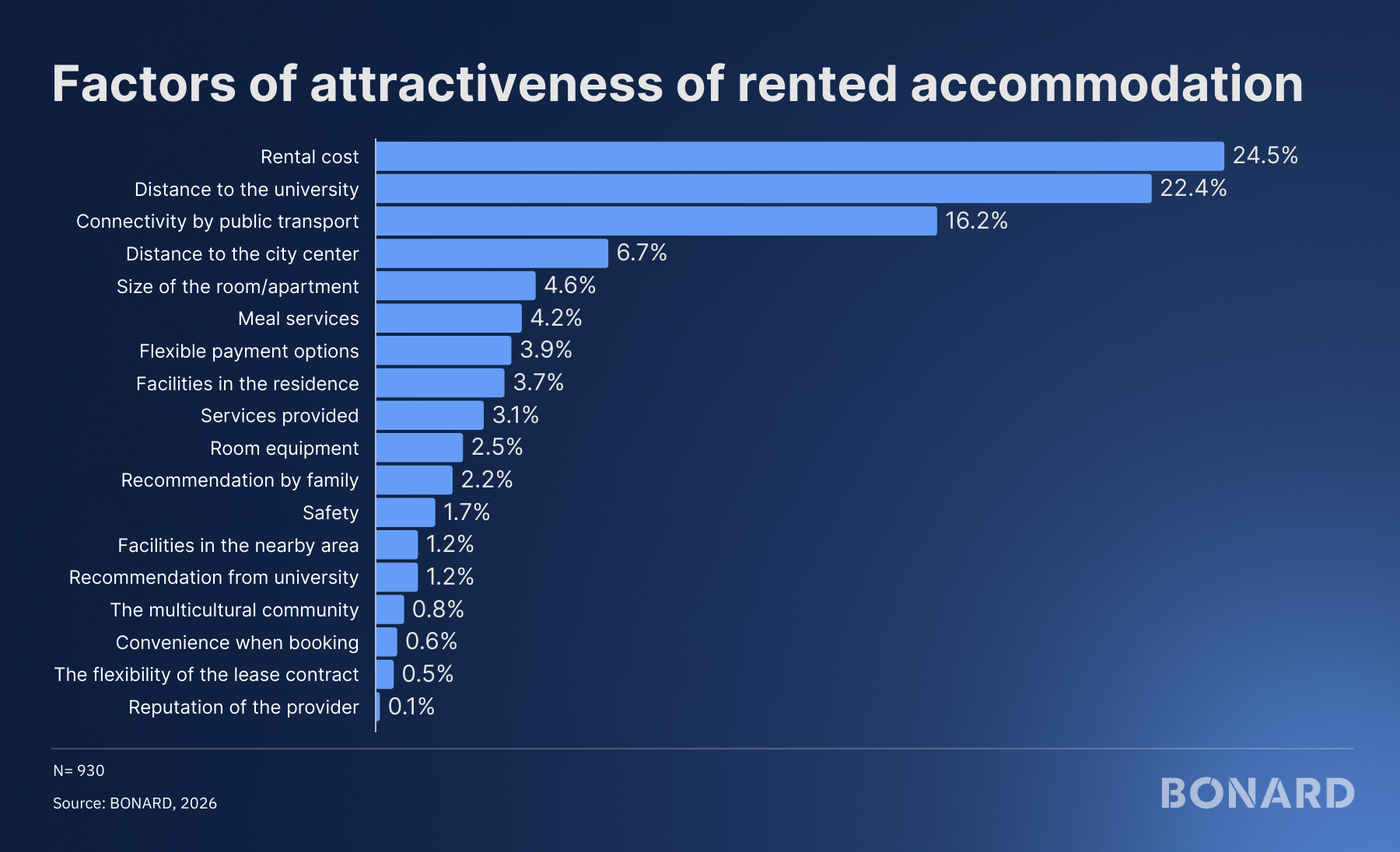
When selecting accommodation, students continue to prioritise core fundamentals.
Rental cost is the most influential factor, accounting for nearly 25% of responses, followed by distance to the university (22% of responses), and connectivity by public transport (16% of responses).
Secondary considerations, which ranked among the factors with medium importance (ranged between 3% and 5% of responses), include:
size of the unit,
meal services,
flexible payment options, and
facilities and services in the residences.
In contrast, factors such as provider reputation, lease flexibility, and booking convenience play a significantly smaller role in the overall attractiveness of student housing.
The current amenity offer falls short of student expectations
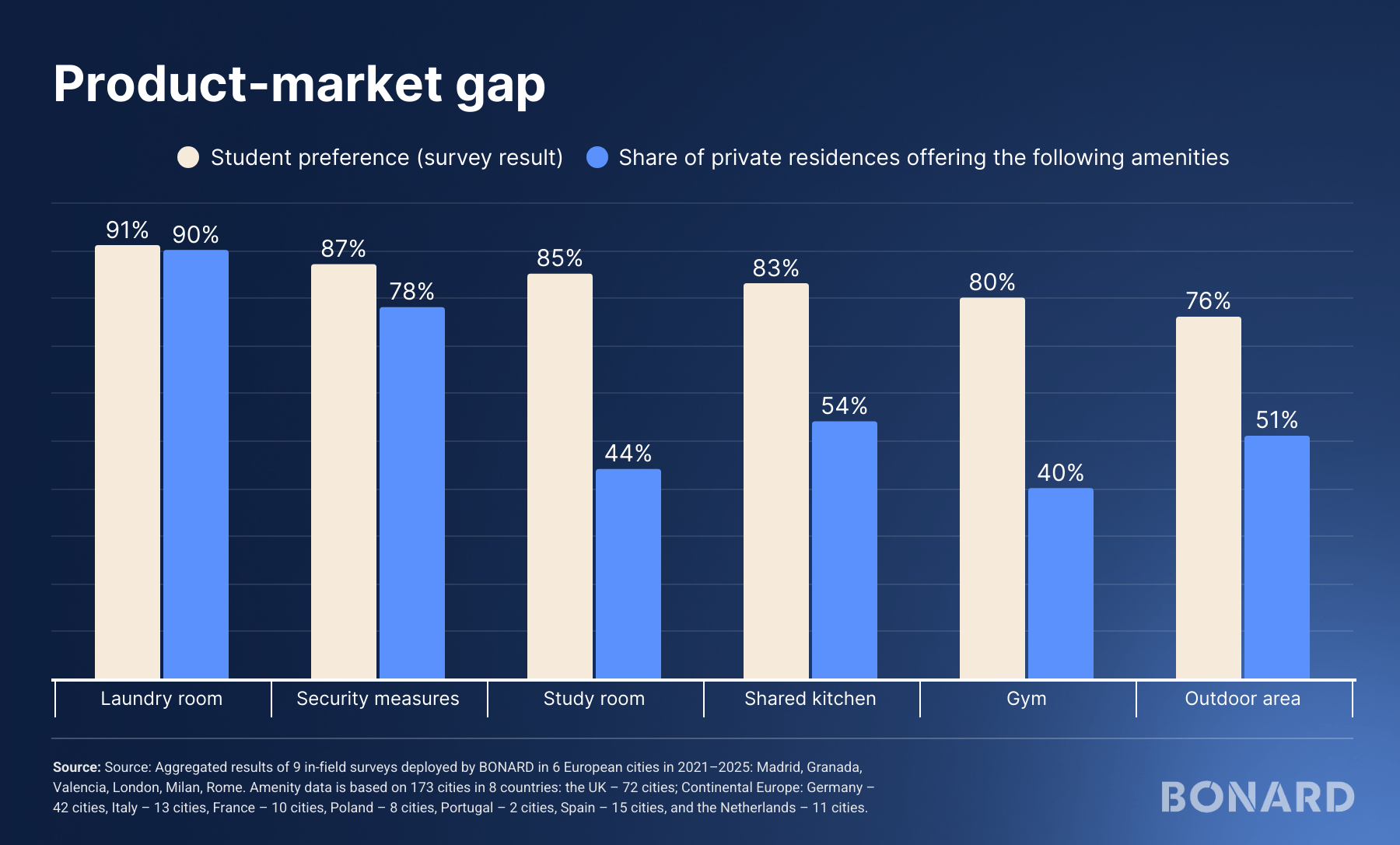
While demand for purpose-built student accommodation continues to grow, the quality and breadth of amenities offered often fail to meet student expectations.
Survey data indicate that students consistently prioritise access to essential services such as:
laundry rooms,
security measures,
study rooms,
shared kitchens,
and gyms.
At the same time, newer concepts such as yoga studios, podcast rooms, and other modern shared spaces are gaining traction.
This reflects evolving expectations around community and lifestyle within student housing.
The amenities and common spaces effectively complement accommodation units, encouraging residents to feel that they are renting the whole building, not just their apartment.
This fosters the sense of community, leading to higher retention rates. However, the current market lags behind the students' preferences.
What does this mean for stakeholders?
As student housing stock continues to expand, the differentiation between assets is increasingly defined by quality rather than quantity.
While essential amenities such as laundry rooms and gyms are becoming standard in high-quality student housing projects, the introduction of modern, community-oriented spaces presents a clear opportunity for developers and operators to enhance asset positioning.

“In student housing, fundamentals like cost and location remain critical, but increasingly it is the quality of the product and amenities that determine how assets perform.”
Andriy Semenov
Senior Real Estate Consultant, BONARD
For a deeper understanding of student housing amenity penetration, including asset-level benchmarks, explore the BONARD Platform or access our latest webinar on this topic:

For tailored advice on aligning student housing developments with tenant preferences and evaluating investment opportunities, contact Filip to explore how he can support your next project.



SUBSCRIBE TO STUDENT HOUSING INSIDER
Stay close to the student housing market
Subscribe to Student Housing Insider for a weekly update on student housing transactions, development pipeline, market trends and selected BONARD analysis.
Designed for investors, developers, operators, lenders and market participants tracking the student housing sector.