


Analysis:
Italy faces a structural PBSA supply gap beyond its main student hubs
Rising student mobility and rapid internationalization are widening Italy's structural PBSA supply gap, leaving a net provision rate of just 10% across major hubs and emerging university cities alike.
If you are short on time:
Italy is facing a severe structural undersupply of dedicated student beds, equivalent to a weighted average net provision rate of 10% – the lowest among Europe's main higher education markets.
The supply gap is evident not only in major student hubs, but also in smaller markets that are emerging as relevant university cities within the country's higher education network. For instance, Milan and Rome together have a shortage of almost 150,000 beds, whereas Padua needs to increase its operational stock tenfold to meet the growing demand.
Italy is actively targeting the internationalisation of its higher education system as part of a dedicated national strategy. This is reflected in a notable uptick in international enrolments across all analysed cities over the last five years, further diversifying the country's student housing needs.
Italy’s higher education market is becoming increasingly dynamic as rising student mobility and internationalisation broaden the range of university cities. This growing potential is attracting increased investment activity from major market players such as Ardian and Rockfield, which acquired 427 beds in Milan, and Invel Real Estate, which entered the sector with an €18 million investment in Stonehill developments in Milan and Padua.
Despite this growing investment activity, the country continues to face a severe shortage of dedicated student accommodation.
Italy's student housing shortage extends beyond the main student hubs
Italy's student housing market is facing a structural mismatch. While demand is broadening across a diverse higher education landscape, PBSA provision remains limited. This shortage is not confined to the country's established student hubs but also affects smaller university cities, which likewise suffer from significant accommodation constraints.
Across 15 student cities analysed here, there are 626,229 mobile students and 59,742 PBSA beds, equivalent to a weighted average net provision rate of 10% only.
This falls significantly short of BONARD's country‑average 72% net benchmark indicating the percentage of mobile students willing to live in PBSA under current market conditions, and represents the largest supply gap among popular European study destinations.
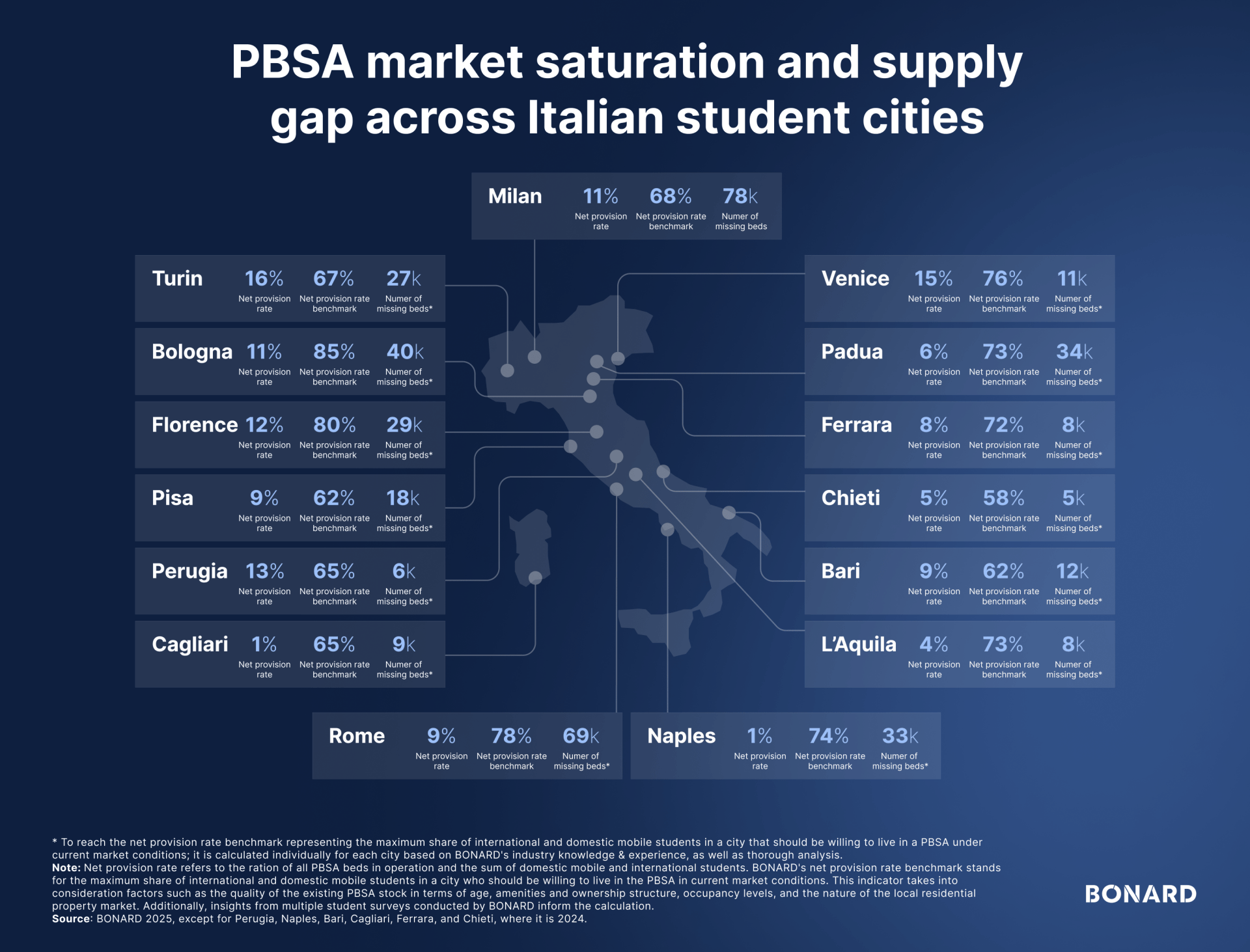
The PBSA gap is structural and geographically broad, present across the whole country. The largest absolute supply gap persists in the leading student hubs, Milan and Rome, driven by a mobile student population of over 100,000 in each city separately and translating to 11% and 9% net provision rate, respectively.
On the other hand, several small to mid‑scale cities experience a significantly more constrained relative supply gap. For example, the ratio of dedicated student beds and mobile students stands at only 1% in Cagliari with L'Aquila and Chieti not exceeding 5% either. These cities represent unique cases where a recognisable higher education landscape meets an entirely undeveloped PBSA market.
Internationalisation reshapes demand across Italian cities
At the same time, student demand is becoming increasingly geographically diverse. For example, Padua, Perugia, and L'Aquila, are evolving into popular destinations for mobile students, as reflected by their 5‑year compound annual growth rates (CAGR) of 4%, 7%, and 6% respectively for domestic and international mobile students combined.
In the case of Padua, the market has recognised the investment opportunity, with the 2026 forward purchase of a 530‑bed development by Kryalos SGR and King Street Capital Management alongside Invel Real Estate's investment in Stonehill's 564‑unit development. Overall, Italy's undersupply is occurring precisely as demand spreads beyond traditional student hubs.
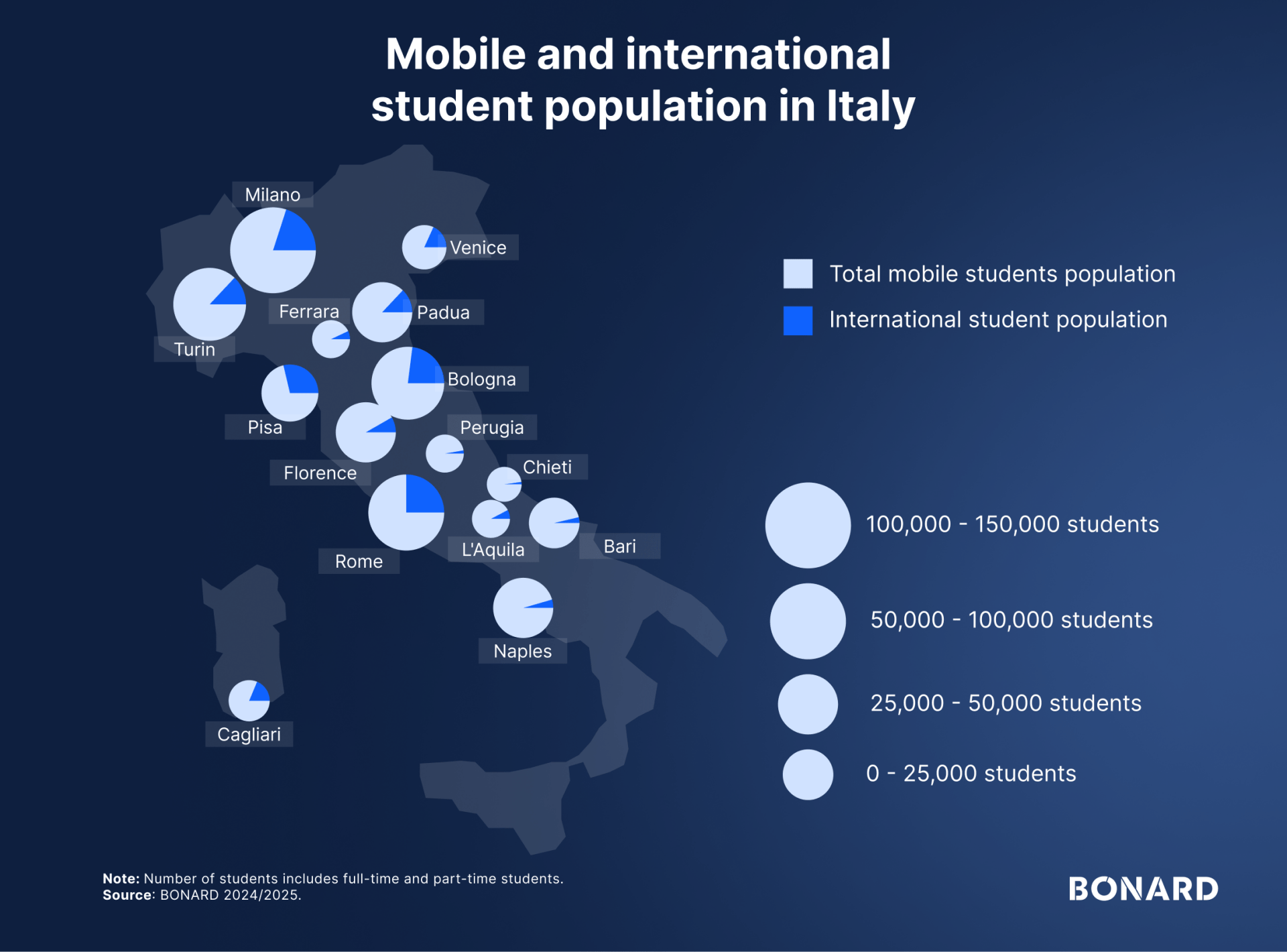
On the other hand, the international student population has been expanding across all cities since the 2019/20 academic year. This positive trend reflects Italy's national higher education strategy, which explicitly targets increased internationalisation through direct promotions abroad, facilitating student and research mobility, and fostering cross‑country academic cooperation. This strategy is supported by a number of English‑taught programmes (Bachelor's: 278; Master's: 137; PhD: 451), which exceed the continental European average at all study levels.
Across markets, mid‑sized cities, particularly Padua, Naples, and Venice, stand out, where the number of foreign students shows at least a 20% CAGR over the last five years. While Venice is relatively better‑supplied compared with other Italian cities (15% net provision rate), Padua and Naples are among the least saturated markets, representing a case study of severe undersupply meeting strong internationalisation.
However, the supply gap is not the only factor putting pressure on the Italian student housing market. Although the country offers affordable higher education, accommodation remains one of the most constrained aspects of the student experience. Easing the supply pressure by increasing the number of dedicated student beds could help to normalise the situation, with a range of options to suit different budgets.
What does this mean for stakeholders?
The persistent PBSA supply gap in Italy, across both established and emerging student cities, points to sustained demand for additional student accommodation.
That demand is beginning to translate into a significant development pipeline and greater institutionalisation of the market – but this activity alone is unlikely to close the gap: the structural shortfall is expected to persist. This leaves room for developers and investors in markets beyond Tier 1 cities.
Nevertheless, understanding local nuances in student growth trends and university infrastructure will be key to capturing investment opportunities in smaller markets. In addition, universities and policymakers will also need to expand.
For a deeper understanding of student housing demand, supply gaps, development pipelines and market-level provision rates, explore the BONARD Platform or learn more about how BONARD supports market selection and investment strategy.

For tailored advice on evaluating student housing opportunities in Italy, contact Filip to explore how he can support your next acquisition or development strategy.


SUBSCRIBE TO STUDENT HOUSING INSIDER
Stay close to the student housing market
Subscribe to Student Housing Insider for a weekly update on student housing transactions, development pipeline, market trends and selected BONARD analysis.
Designed for investors, developers, operators, lenders and market participants tracking the student housing sector.