


Analysis:
Prague PBSA: Supply constraints shaping investment potential
Prague combines the scale of a major European university city with several distinctive demand drivers, falling into TOP-20 largest student populations among the 300 European cities, including the UK, tracked in BONARD’s database. Free Czech-language higher education attracts students from across the country, with domestic mobile students accounting for more than half of the city’s student population and providing a large, stable accommodation base. Demand is further reinforced by Prague’s substantial foreign population, international appeal and comparatively high rents in the conventional private rental market, which narrow the price gap between PBSA and alternative housing.
Despite this depth of demand, the private PBSA market remains fragmented, with only eight private residences offering more than 200 beds. With more than 132,000 students and enrolment forecast to approach 140,000 by 2030/31, Prague represents a mature education market in which institutional-scale student accommodation remains notably underdeveloped.
If you are short on time:
Prague has more than 132,000 students, including 23% international students, with total enrolment forecast to approach 140,000 by 2030/2031.
The city provides around 28,400 student beds, including only 3,800 private PBSA beds, resulting in a net provision rate of 28% and a shortage of nearly 60,000 beds.
International student numbers are projected to reach around 33,000 by 2030/2031, and, given the limited development pipeline, the provision rate is expected to remain low and sustain demand for professionally managed accommodation.
Prague’s Large, Diverse and Growing Student Base Underpins Resilient PBSA Demand
Prague is an established and attractive higher‑education market, supported by a population of more than 1.4 million, approximately 25% of whom are foreign nationals, a large young‑adult cohort, and a strong concentration of universities and colleges. The city currently hosts 23 universities and colleges, five of which are globally ranked, as well as more than 132,000 students, including a sizeable international community representing 23% of the total. Moreover, domestic mobile students represent more than 50% of the total student population, who relocate to Prague from other parts of the country. This creates a broad and diversified demand base rather than reliance on a single student segment.
Its appeal is reinforced by highly regarded institutions, more than 500 English‑taught degree programmes, extensive international partnerships and strong graduate employment prospects. Prague also offers a competitive combination of academic quality, cultural appeal, accessibility and a well‑developed business environment, helping to attract students from across Europe and beyond.
Demand is expected to remain resilient over the coming years. Total university enrolment is forecast to reach almost 140,000, supported by larger domestic age cohorts entering higher education, reflecting the higher number of births recorded in the Czech Republic between 2006 and 2010. At the same time, the international student population is projected to grow by around 1.8% annually, and reach approximately 33,000 by 2030/2031.
From an investment perspective, the scale of the existing market, varied underlying drivers and ongoing enrolment growth underpin a stable outlook for continued uptake of purpose‑built student accommodation.
Prague’s Structural Student Housing Shortage Is Set to Persist Despite New Supply and Alternative Housing Options
Prague’s student housing market remains significantly undersupplied, creating a compelling opportunity for investors. The city currently provides around 28,400 student beds, but only about 3,800 are located within private PBSAs, leaving the professionally managed segment relatively small and and offering limited high-quality accommodation options.
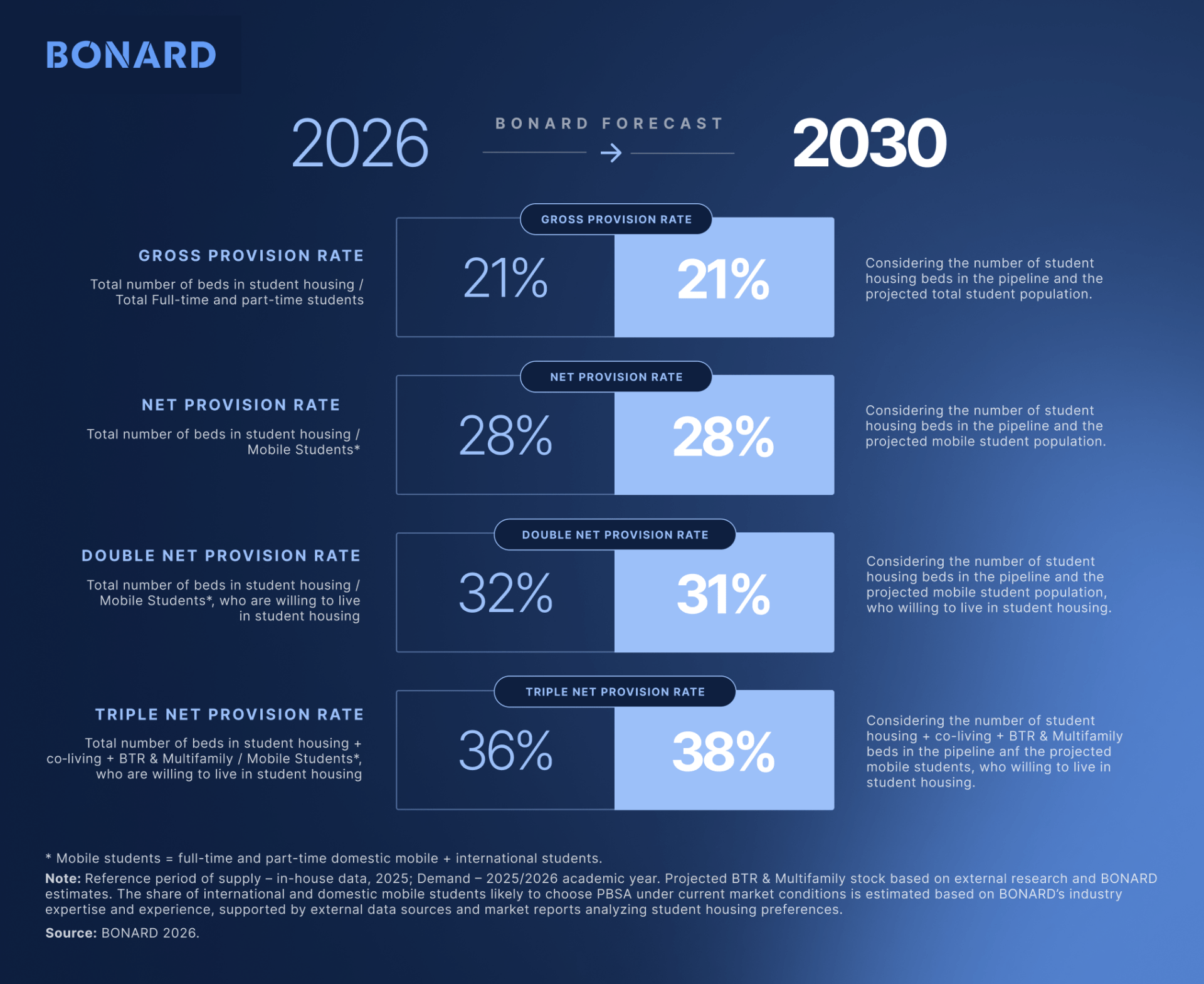
Against a large population of domestic mobile and international students, the net provision rate stands at approximately 28%, which is significantly lower benchmark provision rate (the benchmark net provision rate represents the maximum share of international and domestic mobile students in a city who are likely to reside in PBSA under current market conditions) of 88% for Prague, implying a shortage of nearly 60,000 beds.
However, this severe undersupply is not unique to Prague; it is a widespread challenge across nearby capitals. Budapest and Berlin meet only around 24% and 23% of demand from international and domestic mobile students, respectively, while Warsaw lags even further behind, with a net provision rate of just 11%.
Compared with local student hubs, Prague’s provision rate is lower than Brno’s, which stands at around 32%, highlighting the particularly acute supply‑demand imbalance in the capital despite its considerably larger student population.
The development pipeline is also limited and is not expected to keep pace with the student population growth. As a result, the provision rate is projected to remain low until 2030, reinforcing the structural supply‑demand imbalance. Even after accounting for alternative accommodation such as co‑living, build‑to‑rent and multifamily housing, a substantial share of students seeking dedicated accommodation remains underserved.
What does this mean for stakeholders?
Prague offers a strong and resilient student housing opportunity. Its large and diversified student base, rising international enrolment and continued domestic mobility support long‑term demand, while limited PBSA supply, a low provision rate and a constrained pipeline point to a persistent structural shortage.
This creates clear potential for investors, developers and operators to deliver modern, professionally managed accommodation with strong occupancy prospects.

"Prague’s PBSA market is supported by a large and growing student population, but its investment potential is increasingly defined by a persistent shortage of professionally managed accommodation. With limited new supply and continued growth in domestic and international demand, future performance will depend on delivery timing, product quality, affordability and the ability to address unmet demand."
Karyna Hurdzhyian
Real Estate Consultant, BONARD
For a deeper understanding of student housing demand, supply gaps, development pipelines and market-level provision rates, explore the BONARD Platform or learn more about how BONARD supports market selection and investment strategy.

For tailored advice on evaluating student housing opportunities in Germany and Europe, contact Filip to explore how he can support your next acquisition or development strategy.



SUBSCRIBE TO STUDENT HOUSING INSIDER
Stay close to the student housing market
Subscribe to Student Housing Insider for a weekly update on student housing transactions, development pipeline, market trends and selected BONARD analysis.
Designed for investors, developers, operators, lenders and market participants tracking the student housing sector.