


If you are short on time:
Bratislava has a structural shortage of professionally managed rental housing. In student accommodation, a net provision rate of 61% leaves an estimated shortfall of around 10,127 beds.
The gap is even starker in build‑to‑rent, where BONARD tracks just around 400 beds in a city of nearly 480,000 – a fraction of Prague (2,300+ units) or Kraków (3,500+).
Demand is structural, not speculative: with ownership costing 12.3× the average annual salary and a young, increasingly international population, more residents are turning to renting than the market can currently serve.
Central and Eastern Europe is often described as an emerging market for rented residential. At our recent Rented Residential Summit in Bratislava, we discussed how the demand drivers in Slovakia are already well established, while the supply of professionally managed rental housing, across both student accommodation and build‑to‑rent (BTR), is only now beginning to form.
Early institutional activity is visible: Lucron delivered the country's first institutional BTR project, with 22 units, and operator Zeitraum is entering the market via Lucron's Nesto development in Bratislava.
Despite this early momentum, the country continues to face a severe shortage of purpose‑built rental stock relative to demand.
A structural supply gap across both student housing and build‑to‑rent
Bratislava's rental market faces a structural mismatch. Demand is broadening across students, young professionals and a growing international population, while professionally managed supply remains limited.
In student accommodation, BONARD tracks 18,002total beds in Bratislava, of which only 928 are privately operated. This equates to a net provision rate of 61%, with an estimated shortfall of around 10,127 beds needed to reach the level BONARD considers adequate for the city.
The gap is more pronounced still in build‑to‑rent. BONARD tracks just around 400 BTR beds in Bratislava, a fraction of the professionally managed capacity found in comparable regional markets such as Prague (2,300+ units) or Kraków (3,500+). The pipeline is active but modest, 7 projects in total across the student housing, build‑to‑rent and co‑living segments.
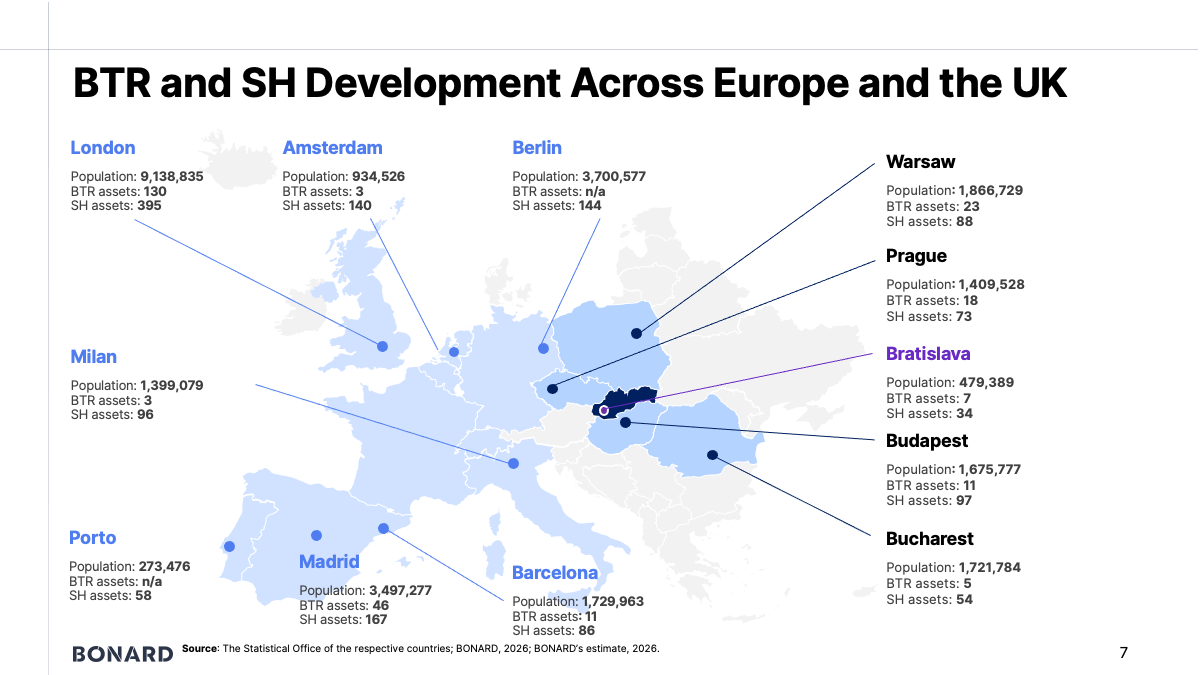
On BONARD's classification, Bratislava is an emerging rental market, earlier in its development than Prague, Kraków or Brno, but with the demand fundamentals already firmly in place.
Affordability and demographics are reshaping demand
Demand rests on several reinforcing, non‑cyclical trends rather than any single factor: a housing shortage, declining affordability of ownership, rising mobility, a growing number of one‑person households, and ongoing urbanisation.
Affordability is the sharpest of these. Buying a standardised 70m² new‑build apartment in Bratislava now requires 12.3 times the average gross annual salary, placing the city among Europe's seven least affordable markets, alongside Košice at 14.2×. The consequences show up in how young Slovaks live, the average age of leaving the parental home is 30.9, against an EU average of 26.2, one of the highest in Europe.
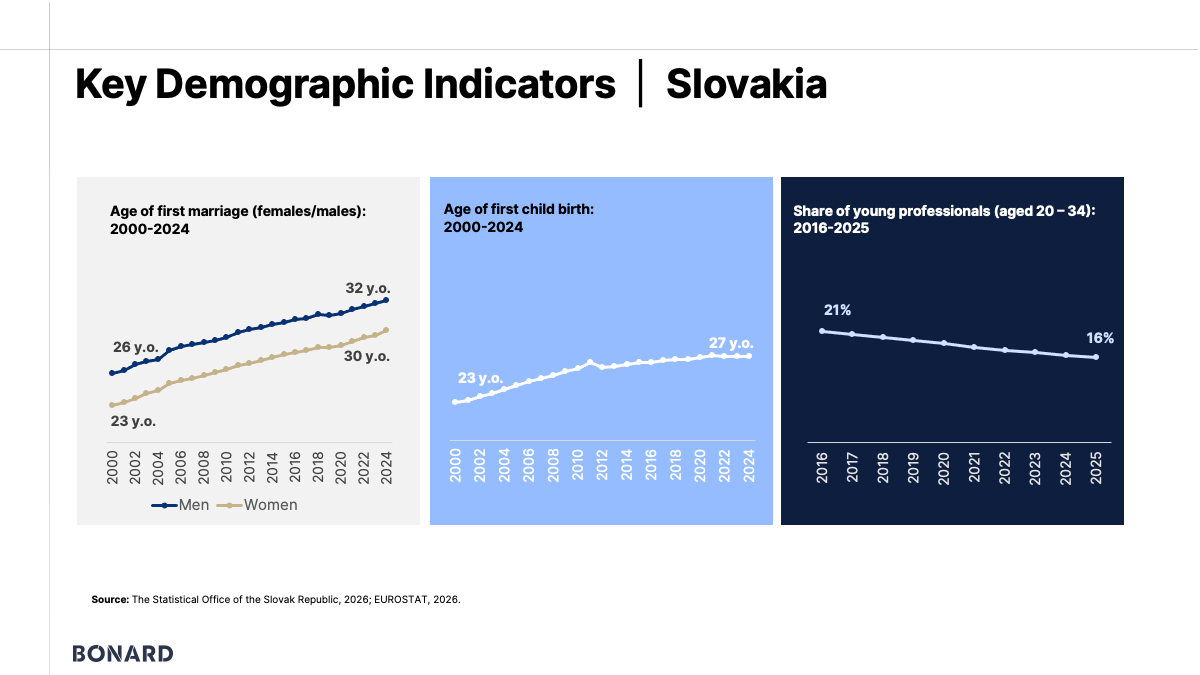
The tenant base is both sizeable and growing. Bratislava's population rose from 419,678 in 2015 to 479,389 in 2025, and the city is now home to roughly 100,000 young professionals aged 25‑39 and around 18,000 foreign residents. The foreign‑resident population has grown at 6.1% a year over the past decade, and the international student population has grown at 11.7% a year over the past five.
Household formation points the same way, with the number of single people across the Bratislava region rising from 265,869 in 2015 to 336,889 in 2025.
What does this mean for stakeholders?
The combination of established demand, minimal supply and an early pipeline points to sustained, structural demand for professionally managed rental housing in Bratislava, across both student accommodation and build‑to‑rent.
That demand is beginning to translate into early institutional activity – the country's first BTR project and the entry of an experienced operator – but this alone is unlikely to close the gap in the near term. For developers and investors, the arrival of a first established operator is often the signal that a market is ready to be operated professionally.
Nevertheless, entering an emerging market brings real friction: financing frameworks built from scratch, an unsettled tax treatment, and a lack of local comparables. Understanding these local nuances and the role of an experienced operator in navigating them will be key to capturing the opportunity.
For more information regarding the CEE rental market, access the presentation from our recent Rented Residential Summit in Slovakia.

"Driven by prohibitive purchasing costs, rising urbanization, and an influx of international residents and students, locals are increasingly relying on a rental market that currently faces deficits of thousands of missing beds."
Terezia Masarykova
Real Estate Consultant, BONARD

Explore Slovakia's rented residential market in greater depth onthe BONARD Platform, or contact Filipfor tailored guidance on your next acquisition or development strategy.



SUBSCRIBE TO STUDENT HOUSING INSIDER
Stay close to the student housing market
Subscribe to Student Housing Insider for a weekly update on student housing transactions, development pipeline, market trends and selected BONARD analysis.
Designed for investors, developers, operators, lenders and market participants tracking the student housing sector.