


If you are short on time:
Australia’s international student trends vary by education sector. Higher education enrolments increased by 2% year‑on‑year in January – May 2026, despite an overall decline in international enrolments.
Australia is tightening international education policy, maintaining 2027 student commencement levels while restricting visa dependants and course progression to better control migration and ease housing pressures.
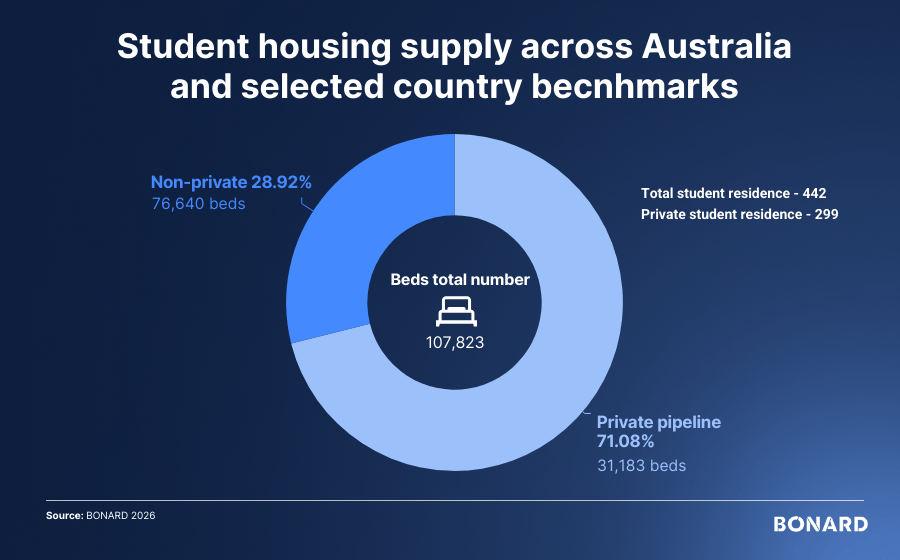
Private PBSA accounts for 71% of total stock across the 6 monitored cities with 442 student residences providing 107,823 beds.
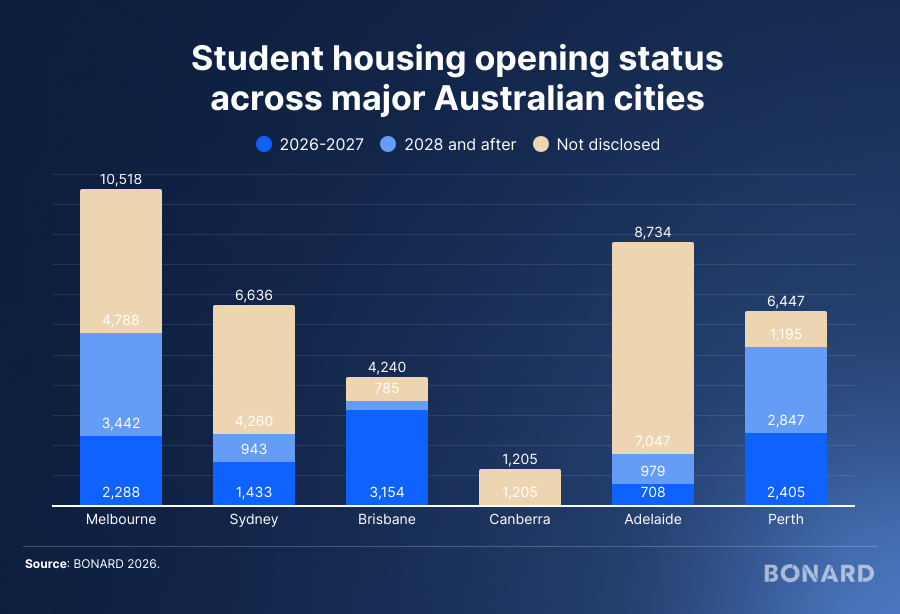
Approximately 10,000 pipeline beds are scheduled for 2026 – 2027 led by Brisbane and Perth. Most of the 8,500 beds expected from 2028 onwards will be located in Melbourne and Perth.
Almost 20,000 beds have undisclosed opening dates, and their delivery and timeline could be subject to the interplay of policy changes and international demand within the Australian market.
Australia’s international education landscape is shaping by changes in recruitment and policy settings, but accommodation developments are continuing across biggest student hubs.
International investors are sustainably interest in Australia's PBSA market, what is showing by their recent transactions highlight heading into 2026, spanning both property ownership and operating platforms. Greystar’s acquire a seven‑asset portfolio in 2025 for a A$1.6 billion and Samty’s acquire UniLodge in late 2025, subsequently reported as more than A$625 million transaction.
Substantial accommodation pipelines are taking shape in Melbourne and Sydney, while Adelaide and Perth are facing particularly large increases relative to their existing stock. Overall, across monitored cities, the current stock is almost 108,000 beds, while approximately 38,000 beds are in planning or under construction within 69 residencies.
Enrolment trends and policy dynamics
Similar to the other “Big Four” countries, Australia is facing adverse challenges as a traditional international education destination. Students are shifting towards other markets driven by affordability, visa certainty, and available English‑taught programmes.
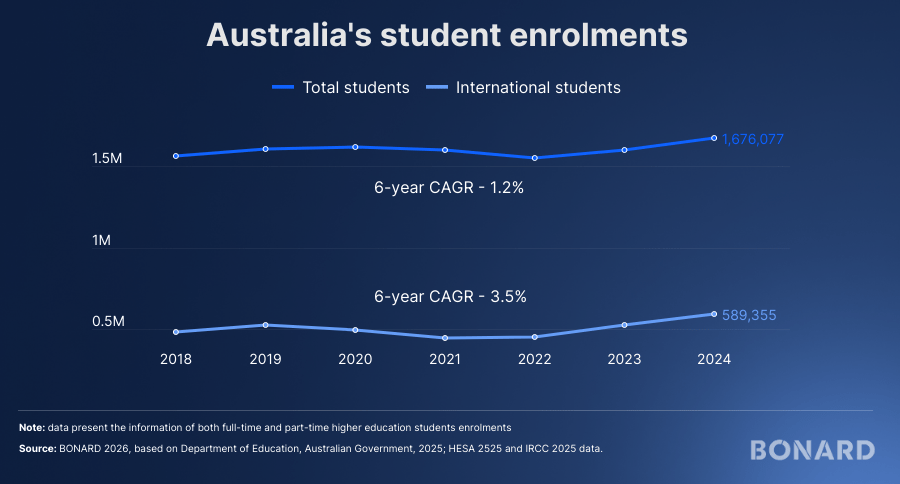
Even though the country is likely to remain under pressure, the underlying picture is much more uneven. Taking a closer look at Australian demand numbers in terms of enrolment between 2018 and 2024, after a steep decline in pandemic academic years, student numbers experienced a recovery. With a 6‑year CAGR for total enrolment of 1.2%, the driver behind the stability is the growth of international enrolment, with a CAGR of 3.5%.
More recent figures show different trends across education sectors. Between January and May 2026, 680,582 international students studied in Australia, 7% fewer than during the same period in 2025. Higher education enrolments were 2% higher, while English Language Intensive Courses for Overseas Students (ELICOS) enrolments were down 27%, making higher education perform better in comparison.
In July 2026, the Federal Government confirmed a National Planning Level of 295,000 international student commencements for 2027, unchanged from 2026 and approximately 9% above the 2025 level.
Demand is continuously being shaped by government migration policies, visa requirements and eligibility, and caps on student numbers. The impact of these measures is reflected in recent visa policy changes and student visa grant figures. After peaking in 2023, student visa grants fell by 13% year‑on‑year in 2024. This downward trend continued in Q1 2026, with 30,492 higher education student visas granted, an 8% year‑on‑year decline.
In a September 2026 speech, Home Affairs Minister Tony Burke also emphasised international education’s contribution to Australia’s urban economies: “There is a whole section of the Australian economy in the cities that is only there because we have an important export industry in international students.” These remarks highlight the wider significance of changes in student recruitment within the country, with implications extending beyond universities to accommodation providers and other businesses serving international students.
Note: Full title of the Hon Tony Burke is Minister for Home Affairs, Minister for Immigration and Citizenship, Minister for Cyber Security, Minister for the Arts, and Leader of the House.
Mostly private and highly concentrated, what does Australia’s current PBSA stock look like?
The stock catering to the current demand across monitored Australian cities counts a total of 442 student residences providing 107,823 beds. The share of private student beds is relatively high, at 71%, especially compared to markets like the UK, with 59% private stock and Canada, with 34%.
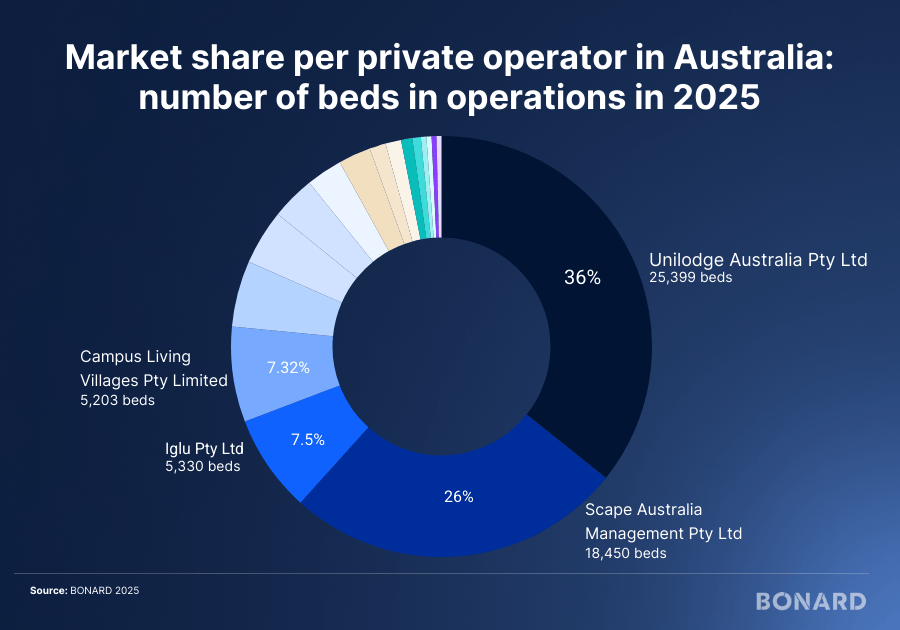
Australia’s private PBSA market is highly concentrated, with four providers accounting for 74% of beds. UniLodge and Scape are the two largest players, with 25,399 and 18,450 beds, respectively.
Emerging student cities spearheading pipeline expansion
Adelaide is doubling its stock, even though the opening dates of most of the pipeline assets are not disclosed yet. Perth is aiming to deliver 2/3 of beds more than the current operational stock, with 1/3 planned for opening already in the next year.
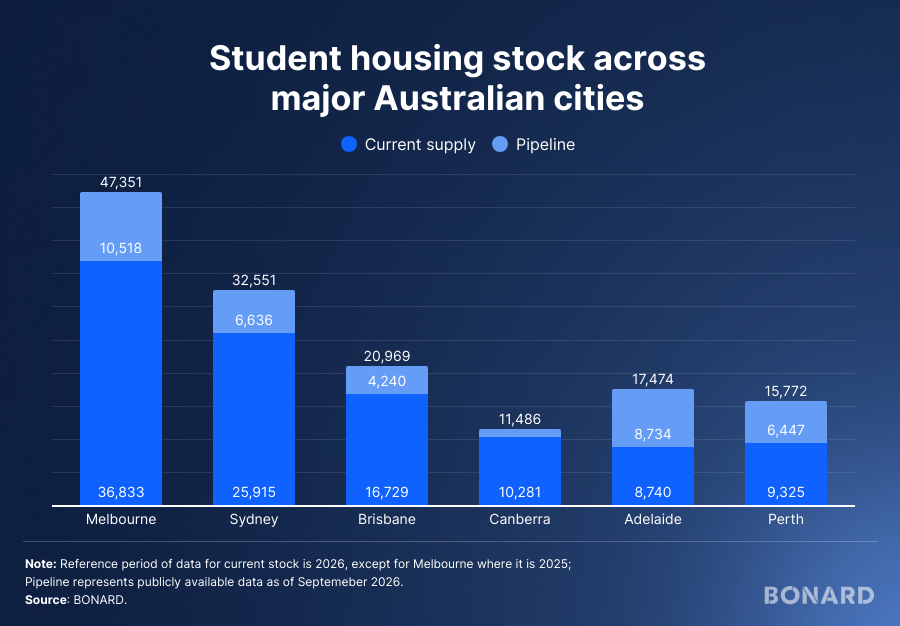
Although Brisbane has only 4,240 beds in the pipeline, it leads in the number of beds to be opened in 2026 – 2027. Melbourne and Perth account for most beds expected from 2028 onwards.
What does this mean for stakeholders?
Australia’s tighter international education policy should not necessarily be read as asign of weakening demand. As the Government itself has indicated, the objective is partly to allow immigration to moderate sufficiently for studenthousing supply to catch up.
For PBSA investors, this reinforces the underlying structural opportunity. Student housing remains undersupplied in several key cities, while a substantial development pipeline is now responding to that imbalance. The combination of persistent accommodation pressure, concentrated existing supply and continued institutional investment suggests that Australia remains a highly attractive PBSA market.

"Australia’s international education sector is undergoing regulatory tightening, leading to an overall decline in student numbers. However, the incoming pipeline demonstrates that investors view current regulatory tightening as a temporary stabilization phase rather than a signal of weakening long‑term demand."
Magdalena Barešić
Real Estate Consultant, BONARD

Explore Italy’s student housing market in greater depth on the BONARD Platform, or contact Filip for tailored guidance on your next acquisition or development strategy.


SUBSCRIBE TO STUDENT HOUSING INSIDER
Stay close to the student housing market
Subscribe to Student Housing Insider for a weekly update on student housing transactions, development pipeline, market trends and selected BONARD analysis.
Designed for investors, developers, operators, lenders and market participants tracking the student housing sector.