


Analysis:
German PBSA market: A Structurally Imbalanced Market with Clear Investment Implications
Germany has reinforced its position as a leading global higher education destination, with international enrolments growing at a 3.6% CAGR over 2019/20 – 2024/25, surpassing 492,000 students in 2024/25.
Despite this robust demand backdrop, the student accommodation market remains structurally undersupplied, with a net PBSA provision rate of just 24%, meaning only around one in four students can be accommodated in student housing, as delivery continues to lag behind demand across most cities.
If you are short on time:
Germany’s higher education market remains resilient, with overall student numbers stable and international enrolments growing at a 3.6% 5-year CAGR, surpassing 492,000 students.
Growth is increasingly driven by global mobility shifts from traditional “Big Four” destinations towards Germany, supported by low tuition fees, strong reputation, and expanding English-taught programmes.
Despite strong demand, the PBSA market remains structurally undersupplied, with a net provision rate of only 24%. As a result, just one in four mobile students can access student housing, highlighting a persistent accommodation gap and an investment opportunity.
Supply constraints are consistent across city tiers, as even established university hubs face structural shortages and pipeline delivery remains insufficient to rebalance the market, reinforcing the depth and persistence of the investment case.
Germany's higher education market benefits from international student growth
Although Germany has faced demographic headwinds and a slight decline in domestic student numbers, it continues to strengthen its position as a leading global higher education destination.
492k
Student ENROLMENTS
3,6%
CAGR
From the 2019/20 to the 2024/25 academic year, the overall student population remained broadly stable, while international enrolments grew at a CAGR of 3.6%, surpassing 492,000 students. This growth has been driven by shifting global mobility trends, as stricter immigration and study policies in the traditional “Big Four” destinations — the US, the UK, Australia, and Canada — have redirected student demand towards more accessible and stable markets. Germany is well‑positioned to benefit from this trend, supported by low or no tuition fees, a reliable visa framework, a strong academic reputation, and an expanding range of English-taught programmes.
Germany leads Europe in the number of English‑taught master’s programmes
Germany’s PBSA stock would need to triple to meet existing demand
Despite demand remaining strong, the supply of student accommodation continues to fall short. The current net provision rate in Germany is 24%, so only about one quarter of international and domestic mobile students who prefer PBSA can be accommodated. This ratio has remained stable over the past five years (23% in 2022), indicating limited structural improvement despite a growing development pipeline. Persistent undersupply is driven by strong demand fundamentals, including sustained growth in international student numbers, increased domestic mobility, and an ongoing shortage of student housing.
Berlin Case Study:
Even after accounting for Co-living and BTR, Berlin faces a persistent student housing undersupply
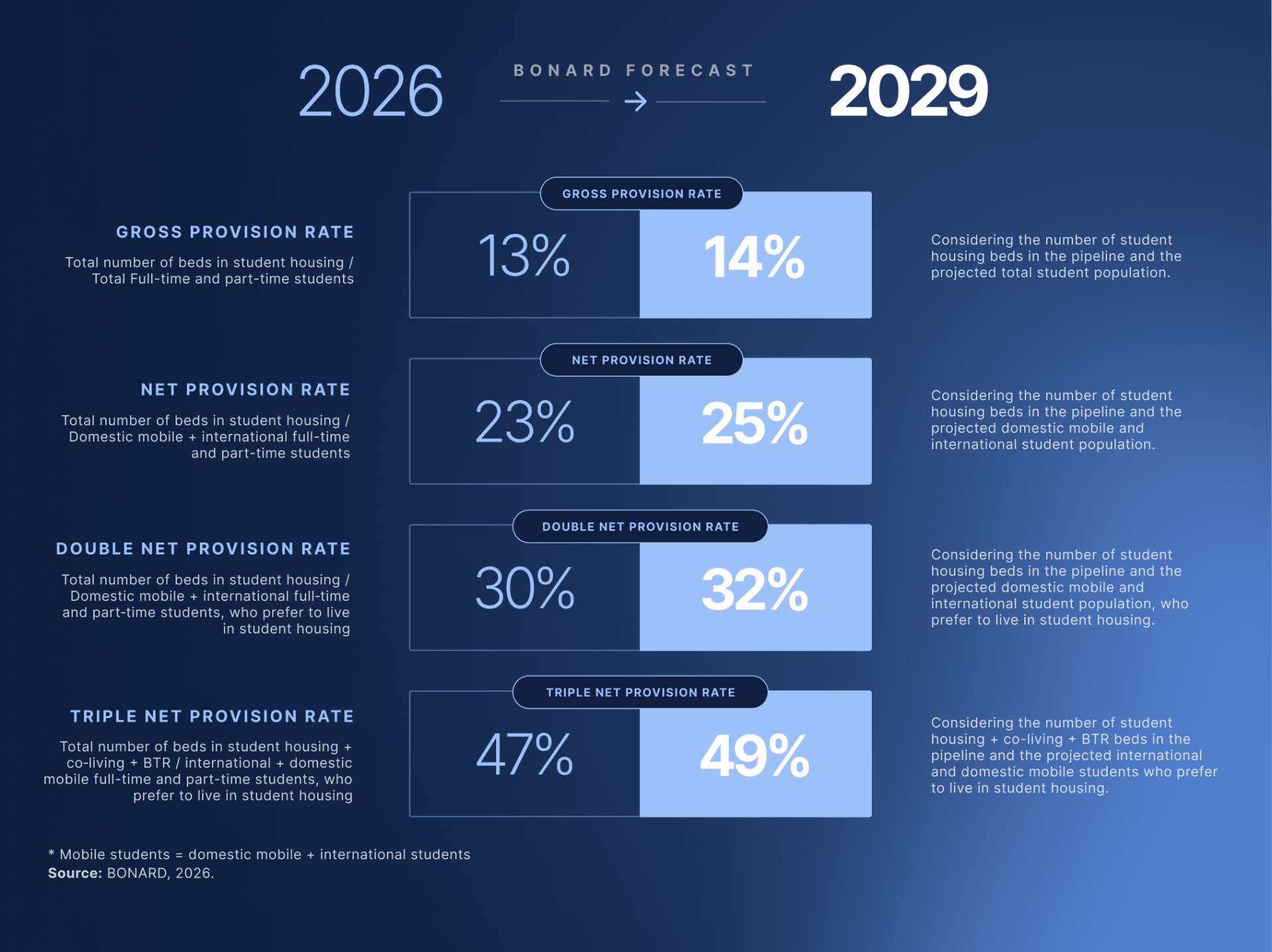
High resolution is available here
Note: Reference period of student housing and co-living supply — in-house data, 2026; BTR — external sources analysis, 2026. Demand — 2024/2025 academic year. The share of international and domestic mobile students likely to choose PBSA under current market conditions is estimated based on BONARD’s industry expertise and experience, supported by external data sources and market reports analyzing student housing preferences
Germany's PBSA market faces a persistent supply-demand gap
At the city level, the market is not defined by a simple “high vs low demand” split, but by a persistent structural shortage of PBSA stock, with supply gaps forming the dominant part of total accommodation need across most locations. Even in established university cities, existing stock meets only a limited portion of demand, due to historical undersupply relative to student growth and internationalisation.
Although new pipeline activity exists, it remains insufficient to materially close the gap, typically offsetting only a small portion of unmet demand. As a result, undersupply remains a structural feature across all city tiers.
What does this mean for stakeholders?
Germany’s PBSA market is defined by a structural imbalance rather than cyclical demand shifts, which is unlikely to self-correct in the near term. Continued internationalisation and limited accommodation coverage will sustain tight competition for quality assets and development opportunities. As a result, performance will be increasingly driven by execution, location, and timing, with new supply largely absorbed without materially changing market fundamentals.

"Germany's PBSA market faces a structural, persistent supply-demand imbalance across all city tiers with just 24% net provision, undersupply won't self-correct and will keep driving competition for quality assets."
Olha Kriukova
Real Estate Consultant, BONARD
For a deeper understanding of student housing demand, supply gaps, development pipelines and market-level provision rates, explore the BONARD Platform or learn more about how BONARD supports market selection and investment strategy.

For tailored advice on evaluating student housing opportunities in Germany and Europe, contact Filip to explore how he can support your next acquisition or development strategy.

SUBSCRIBE TO STUDENT HOUSING INSIDER
Stay close to the student housing market
Subscribe to Student Housing Insider for a weekly update on student housing transactions, development pipeline, market trends and selected BONARD analysis.
Designed for investors, developers, operators, lenders and market participants tracking the student housing sector.